
Ad
Smartphones Linked to Declining Birth Rates in India and Globally
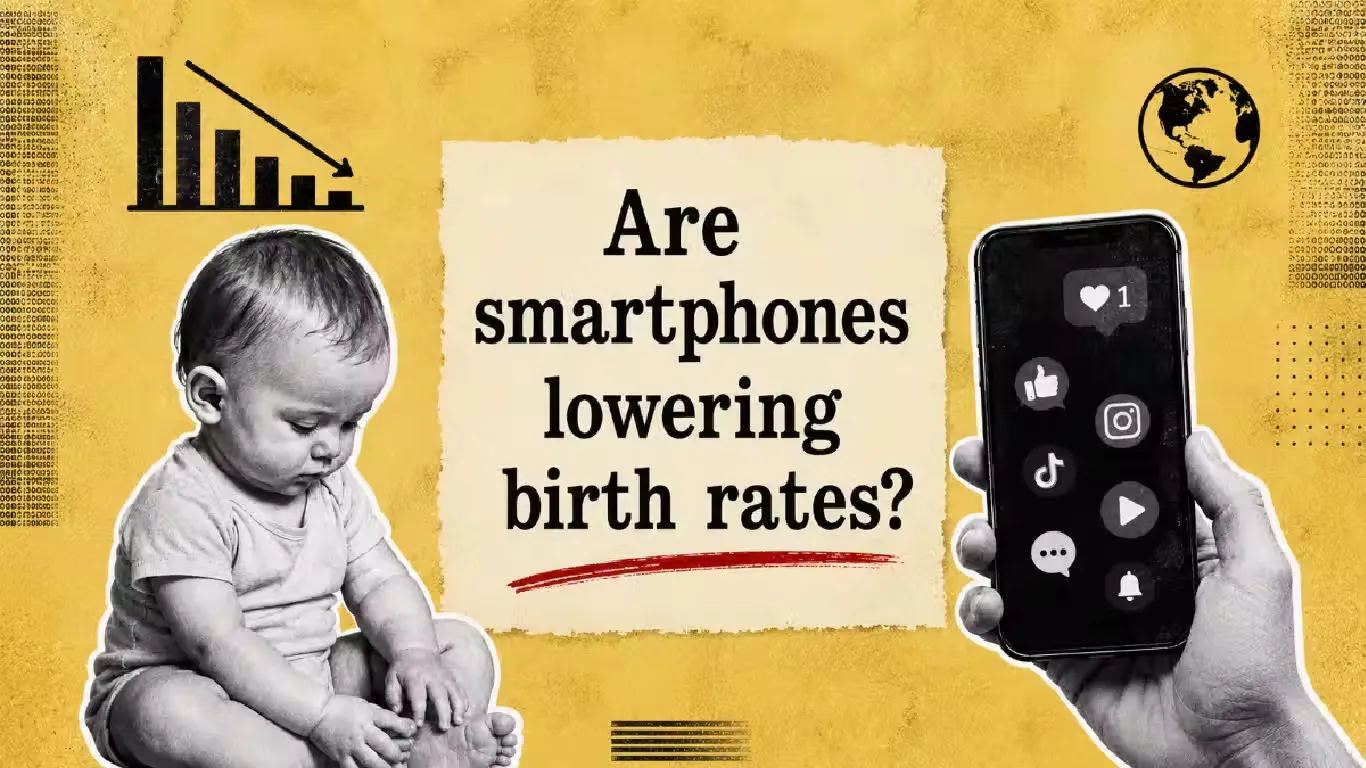
India’s population growth is slowing. Three decades ago, Indian women had an average of 3.4 children. Today, that figure has dropped to 2.0 children per woman, according to government survey data. This is now below the replacement level of 2.1, the threshold needed to maintain population size without migration. Globally, many countries are experiencing a similar trend, with birth rates falling sharply. In several nations, the average number of children per woman is now closer to one than two, and in some places, the most common number is zero.
Key Highlights
- India's fertility rate dropped from 3.4 to 2.0 children per woman over three decades.
- Researchers link declining birth rates to increased smartphone and digital platform use.
- Study found sharper birth rate declines in areas with early 4G mobile internet access.
- Social media use may affect relationship stability and readiness for parenthood.
- Experts say technology accelerates an existing global demographic shift.
Factors Behind Falling Birth Rates
Experts have long cited rising living costs, expensive housing, delayed marriages, career pressures, and changing social norms as reasons for declining fertility. These factors remain important. However, researchers are now examining the role of smartphones and digital platforms in changing human relationships and possibly affecting birth rates.
A recent study by Nathan Hudson and Hernan Moscoso-Boedo from the University of Cincinnati analyzed birth rates alongside the introduction of 4G mobile internet in the US and UK. Their research found that birth rates started to decline earlier and more sharply in regions that received high-speed mobile connectivity first. The researchers suggest that smartphones have fundamentally altered how young people interact, shifting more social time online and reducing face-to-face contact. This decrease in in-person interaction may have contributed to lower fertility rates.
This pattern is not limited to the US and UK. Financial Times analysis found that birth rates in several countries began to fall sharply around the same time smartphones became widely available. In the US, Britain, and Australia, birth rates among teenagers and young adults stayed relatively stable in the early 2000s but dropped noticeably after 2007, when smartphones and mobile apps became mainstream. The decline was most pronounced among younger age groups, who are also the heaviest users of smartphones.
Impact of Social Media on Relationships
Researchers believe the effects go beyond reduced physical interaction. Finnish demographer Anna Rotkirch notes that heavy social media use among young adults is linked to higher levels of sexual dysfunction in couples. She argues that social media may make it harder to build and maintain long-term relationships. Platforms often expose users to curated lifestyles, economic anxieties, and social comparisons, which can create feelings of insecurity and instability.
Some researchers think digital platforms may also amplify concerns about finances, careers, and housing, making young people feel less ready for parenthood. Earlier studies have shown that media consumption can influence family planning decisions. For example, television soap operas depicting smaller families were linked to women choosing to have fewer children. Another study found that owning a television was associated with couples having sex less frequently. Researchers now suggest smartphones could have an even greater impact because they are more immersive, personal, and time-consuming than television.
While experts caution that technology is not the only reason for declining birth rates, many believe it is accelerating a demographic shift that was already underway.
Ad

Zoho’s Sridhar Vembu Warns AI Cannot Solve Global Economic Challenges
Zoho founder Sridhar Vembu warns that AI alone cannot resolve global economic issues and links layoffs to rising cost pressures. Zoho maintains office work policy, focusing on in-person collaboration and sustainability initiatives.
19-May-2026 07:30 AM

Motorola Edge 70 Pro+ Teased for India With New Design and Camera Features
Motorola has teased the Edge 70 Pro+ for India, revealing a design similar to the global Edge 70 Pro. The device will offer portrait photography at 85mm focal length and three finish options, with more details expected soon.
19-May-2026 06:30 AM

Leaked Renders Reveal Motorola Edge (2026) Design Changes Ahead of Launch
Leaked renders of the Motorola Edge (2026) show a flat display, slim bezels, and a triple rear camera setup with a Sony LYTIA sensor. The device is expected to launch soon, with more details anticipated.
19-May-2026 02:30 AM

SandboxAQ and Anthropic Partner to Bring Scientific AI Models to Claude Assistant
SandboxAQ and Anthropic have partnered to bring physics-grounded scientific AI models to Claude, enabling researchers to use advanced drug discovery and materials science tools through natural language without specialized infrastructure.
19-May-2026 01:30 AM

Samsung Expands One UI 8.5 Stable Update to Four More Smartphones in South Korea
Samsung has rolled out the stable One UI 8.5 update to the Galaxy A36, A56, Z Fold5, and Z Flip5 in South Korea. The update includes firmware version A366NKSU6CZDA for the Galaxy A36, with other models to follow.
19-May-2026 12:30 AM

Telegram Introduces Bot-to-Bot Communication and New Automation Features
Telegram has introduced bot-to-bot communication, chat automation, and guest bots, allowing bots to interact, automate workflows, and respond in chats while maintaining user privacy. These updates expand Telegram's automation capabilities.
18-May-2026 11:30 PM
Ad
Ad






Latest Televisions In India






Upcoming Televisions In India





Ad
Ad
 |
|
Delente Technologies Pvt. Ltd.
807, 808, 8th Floor,
IRIS Tech Tower Sohna Road Sector 48,
Gurugram, Haryana - 122018