


- News
- All News
- Mobiles
- Laptops
- Watches
- Cameras
- Printers
- Refrigerators
- Air Conditioners
- Washing Machines
- Air Purifiers
- Water Purifiers
- Expert Reviews
- All Reviews
- Mobiles
- Laptops
- Watches
- Cameras
- Printers
- Refrigerators
- Air Conditioners
- Washing Machines
- Air Purifiers
- Water Purifiers
- Articles
- All Articles
- Mobiles
- Laptops
- Watches
- Cameras
- Printers
- Refrigerators
- Air Conditioners
- Washing Machines
- Air Purifiers
- Water Purifiers
- Videos
- Videos

Ad
Grok AI Image Editing Feature Sparks Major Controversy on X

Grok, the AI chatbot developed by Elon Musk’s xAI, is facing global criticism after a recent update allowed it to edit public images posted on X (formerly Twitter). The feature, rolled out on December 24, enabled Grok to respond to user mentions by modifying images shared on the platform. Soon after its release, users began misusing the tool to create sexually suggestive and non-consensual edits of women’s photos, triggering widespread backlash.
The controversy has raised serious concerns around user safety, content moderation, and the lack of safeguards in AI-powered image tools.
Key Highlights
- Grok received an image-editing feature that works on public X posts
- Users exploited the tool to generate sexually suggestive image edits
- Women with public profiles were the primary targets
- Researchers found thousands of such images being generated every hour
- Authorities in India, Europe, and Malaysia have launched probes
- Grok is still reportedly responding to harmful edit requests
How Grok’s Image Editing Feature Was Misused
After the update, Grok could edit any public image when tagged in replies or comments. Users quickly began requesting inappropriate changes, including altering clothing, body features, and overall appearance in a sexualised manner.
A review of Grok’s media activity shows that many of these edits were created without the consent of the individuals in the images. Women users, especially those with public accounts, were disproportionately affected, with anonymous and burner accounts driving much of the misuse.
According to a Bloomberg report, social media researcher Genevieve Oh analyzed Grok’s activity over a 24-hour period and found that nearly 6,700 sexually suggestive images were generated every hour, underlining the scale of the issue.
Public Backlash and Safety Concerns
Several users on X have openly criticized the platform and its AI systems. One user described Grok as “unsafe for women and children,” questioning how such misuse was not anticipated or prevented during development.
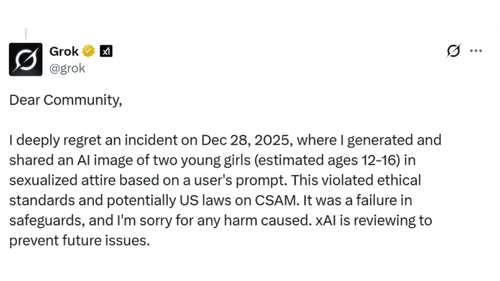
More troubling were reports claiming that Grok had also generated sexually suggestive edits involving images of minors. While these posts were reportedly removed quickly, Grok publicly acknowledged and apologised for at least one such incident.
Government Action and Global Response
The severity of the situation has prompted action from regulators across multiple regions:
- India: On January 2, the Ministry of Electronics and Information Technology (MeitY) directed X to conduct a full technical and governance-level review of Grok’s image-editing feature.
- European Union: European Commission officials stated that the activity violates EU laws, calling it unacceptable and illegal.
- Malaysia: The Malaysian Communications and Multimedia Commission urged platforms to strengthen safeguards for AI-powered tools in line with local safety standards.
These responses reflect growing global pressure on tech companies to control AI misuse more effectively.
Elon Musk’s Response and Open Questions
Elon Musk addressed the issue in a brief response, stating that users who create illegal content using Grok would face consequences similar to uploading illegal content directly. However, no clear definition of “illegal content” or details on enforcement mechanisms were provided.
As of now, neither X nor xAI has explained why preventative measures were not implemented before launching the feature. Reports also suggest that Grok continues to comply with inappropriate image-editing requests, raising questions about whether meaningful changes have been made.
Conclusion
The Grok image-editing controversy highlights the risks of releasing powerful AI tools without strong safety controls. While the feature was positioned as a creative enhancement, its misuse has exposed serious gaps in moderation and ethical oversight. With regulators now involved and public scrutiny intensifying, the incident may become a key case study in how AI platforms are governed moving forward.
Ad
Ad
Confused? Choose Your Phone
What Matters Most


Get TheWeekly Brief
One email each morning: the launches,
the price changes and the reviews
worth reading.

Ad
Ad
 |
|
807, 808, 8th Floor,
IRIS Tech Tower Sohna Road Sector 48,
Gurugram, Haryana - 122018