


- News
- All News
- Mobiles
- Laptops
- Watches
- Cameras
- Printers
- Refrigerators
- Televisions
- Air Conditioners
- Washing Machines
- Air Purifiers
- Water Purifiers
- Expert Reviews
- All Reviews
- Mobiles
- Laptops
- Watches
- Cameras
- Printers
- Refrigerators
- Televisions
- Air Conditioners
- Washing Machines
- Air Purifiers
- Water Purifiers
- Articles
- All Articles
- Mobiles
- Laptops
- Watches
- Cameras
- Printers
- Refrigerators
- Televisions
- Air Conditioners
- Washing Machines
- Air Purifiers
- Water Purifiers
- Videos
- Videos

Ad
Front Load vs Top Load Washing Machines: Which One to Buy?


on Google
on Google
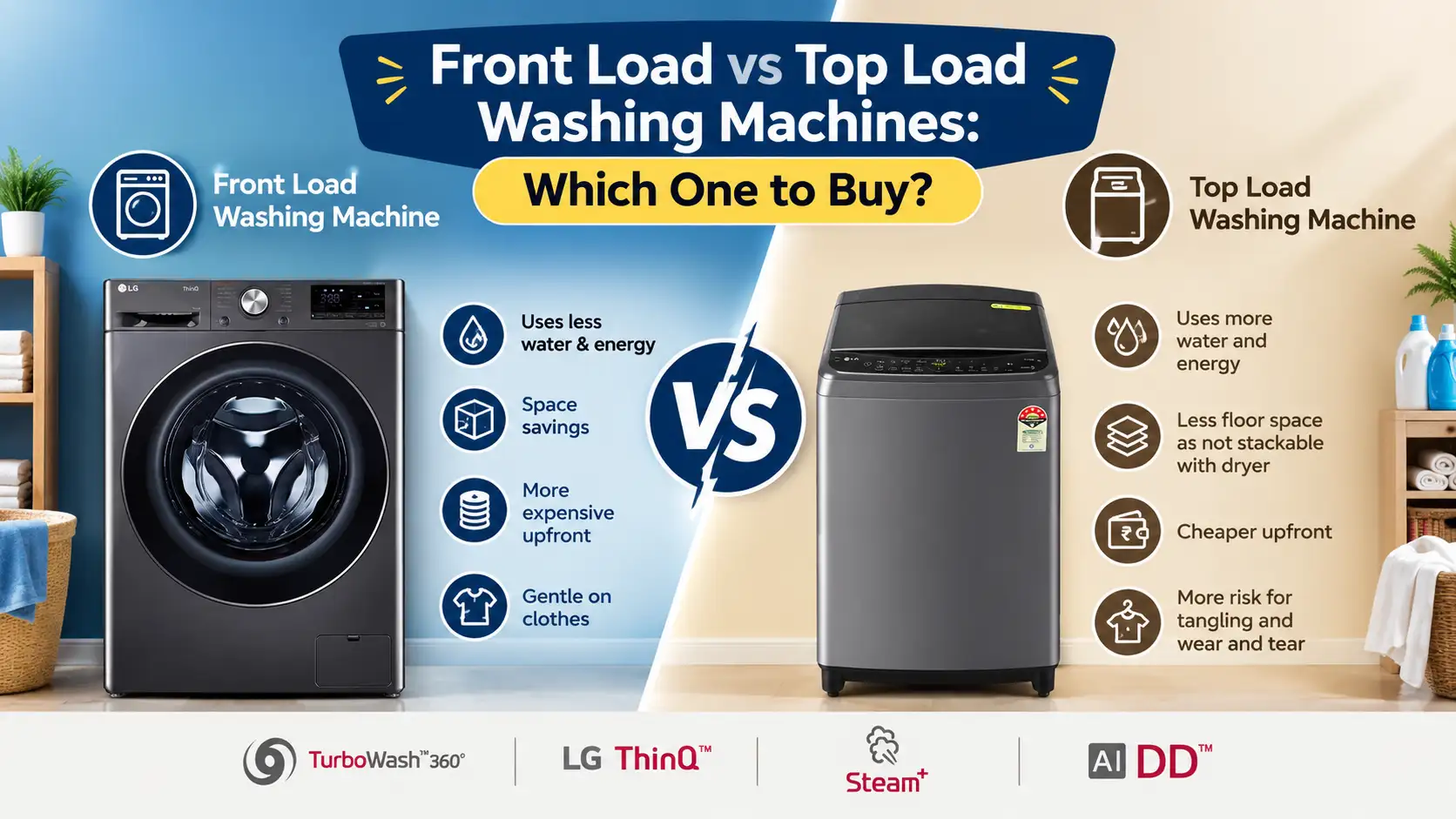
Choosing a washing machine involves more than simply checking its capacity or price. The biggest decision for many buyers is whether to choose a front load or top load washing machine. Both types offer useful features, but they differ in water consumption, cleaning performance, convenience, maintenance and upfront cost.
Front load washing machines are generally known for efficient cleaning, lower water consumption and higher spin speeds, while top load models are often preferred for their affordable pricing, easier loading and shorter wash cycles. The right choice ultimately depends on household size, laundry habits, available space and budget.
Front Load vs Top Load Washing Machines: Key Differences
The basic difference lies in how clothes are loaded and washed. Front load washing machines have a door at the front and use a horizontal drum that tumbles clothes through a relatively small amount of water. This washing action can provide thorough cleaning while using less water.
Top load machines have an opening on the top and use a vertical drum. Depending on the model, clothes are moved using an agitator, pulsator or impeller. Since the washing process generally uses more water, top load machines can be less water-efficient, although modern models have introduced several efficiency-focused features.
Feature | Front Load Washing Machine | Top Load Washing Machine |
Loading | Front-facing door | Top-facing lid |
Washing action | Horizontal drum tumbling | Vertical drum with pulsator, agitator or impeller |
Water usage | Generally lower | Generally higher |
Cleaning | Strong cleaning performance | Effective everyday cleaning |
Spin speed | Usually higher, around 1,200–1,500 RPM in many models | Generally lower |
Drying time | Shorter due to higher spin speeds | Usually longer |
Fabric care | Generally gentler | Can be rougher depending on wash mechanism |
Upfront price | Generally higher | Generally more affordable |
Loading convenience | Requires bending | Easier to load without bending |
Space flexibility | Can be stacked in suitable setups | Usually cannot be stacked |
Mid-cycle loading | Usually limited | Easier on many models |
Maintenance | Door gasket needs regular cleaning | Generally simpler routine maintenance |
Which Washing Machine Offers Better Cleaning and Efficiency?
For households prioritising cleaning performance and resource efficiency, a front load washing machine can be a practical choice. The tumbling action lifts and drops clothes repeatedly, allowing detergent and water to move through fabrics effectively. Higher spin speeds also remove more water from clothes before they are taken out of the machine.
This can be particularly useful during humid weather or when drying space is limited because clothes can come out relatively less wet. Front load machines also tend to consume less water, which can contribute to lower water usage over the appliance's lifetime.
Top load washing machines, however, remain convenient for everyday laundry. Their upright design makes it easier to add and remove clothes without repeatedly bending down. Many models also offer relatively quick wash cycles, making them suitable for households that prioritise convenience and speed.
Buying Factor | Front Load | Top Load |
Cleaning performance | Excellent for varied loads | Good for regular laundry |
Water efficiency | Higher | Moderate |
Energy efficiency | Generally higher | Varies by model |
Spin performance | Higher | Generally moderate |
Clothes drying time | Usually shorter | Usually longer |
Ease of loading | Requires bending | Easier |
Wash-cycle speed | Often longer | Often faster |
Front Load vs Top Load: Which One Should Buyers Choose?
A front load washing machine makes sense when cleaning quality, water efficiency and fabric care are important priorities. It can also work well in homes where floor space is limited and a compatible dryer or appliance can be stacked above it.
However, front load machines generally have a higher purchase price. The front door gasket also needs to be wiped and dried regularly to reduce the risk of moisture-related odours or mould. The loading position can also be less convenient for people who find bending uncomfortable.
A top load washing machine can be a better fit when the purchase budget is tighter or loading convenience is a major consideration. Models from major brands can be available in the ₹20,000–₹25,000 range, including several feature-rich options.
Top load machines also make it easier to add forgotten clothes during a cycle on models that support this function. Their main compromises can include higher water consumption and less efficient spin performance compared with many front load alternatives.
Buyer Requirement | Suitable Type |
Lower water consumption | Front Load |
Strong cleaning performance | Front Load |
Shorter drying time | Front Load |
Easier loading and unloading | Top Load |
Lower initial budget | Top Load |
Quick everyday washing | Top Load |
Stackable laundry setup | Front Load |
Frequent delicate or mixed loads | Front Load |
Adding clothes during washing | Top Load |
Minimal bending | Top Load |
FAQs
1. Which is better, front load or top load washing machines?
The choice depends on household priorities. Front load machines generally offer better water efficiency, higher spin speeds and strong cleaning performance, while top load models are typically more affordable and easier to load.
2. Do front load washing machines use less water?
Yes. Front load washing machines generally use less water because their horizontal drums tumble clothes through a smaller amount of water rather than filling a large tub.
3. Are top load washing machines cheaper than front load models?
Generally, yes. Top load washing machines are available across a wider range of affordable price points, while front load models typically have a higher upfront purchase cost.
Ad
Ad
Confused? Choose Your Phone
What Matters Most


Get TheWeekly Brief
One email each morning: the launches,
the price changes and the reviews
worth reading.

Ad
Ad
 |
|
807, 808, 8th Floor,
IRIS Tech Tower Sohna Road Sector 48,
Gurugram, Haryana - 122018