



Ad
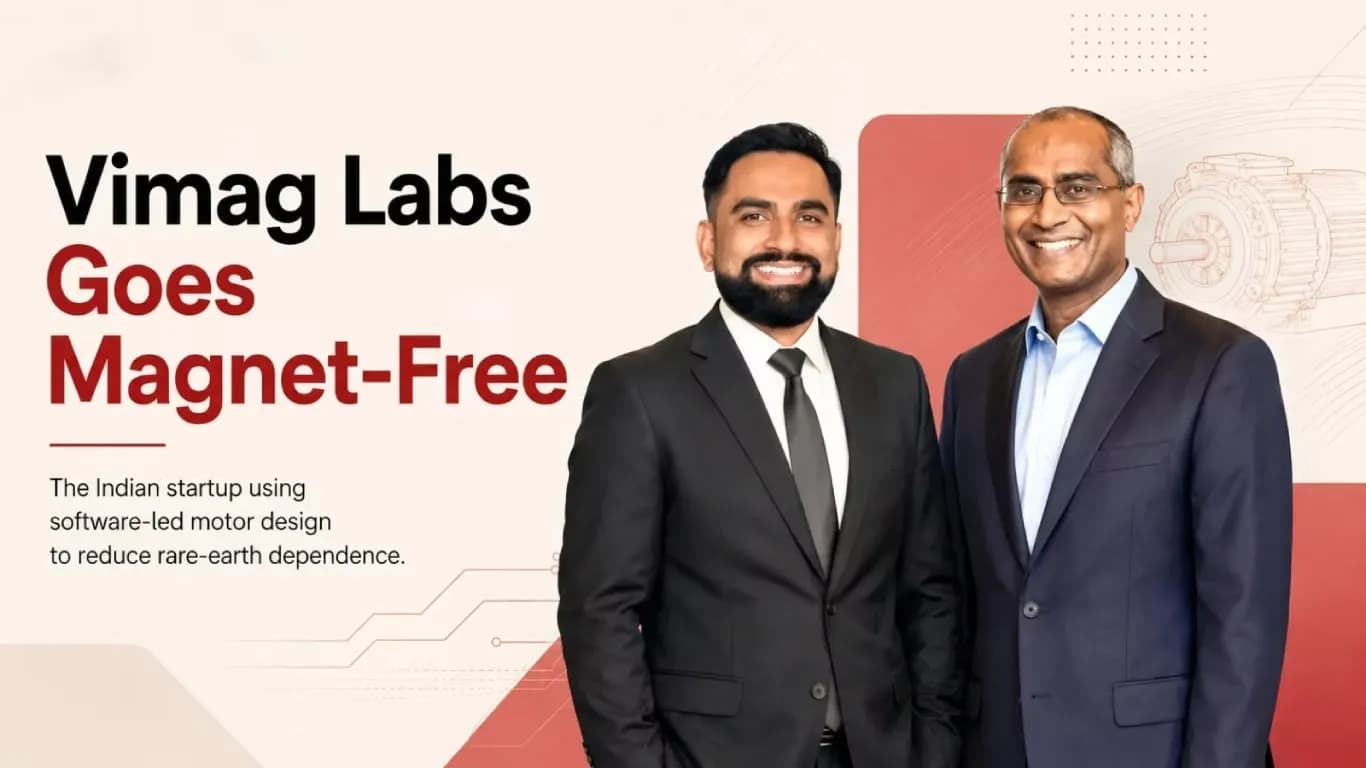
Indian Startup Vimag Develops Magnet-Free EV Motor to Reduce Rare Earth Dependency



Follow Us:


5,113 views
Vimag, a Bengaluru-based startup, has introduced a new electric vehicle (EV) motor that eliminates the need for rare earth materials. This innovation comes as global automakers, including Tesla, seek alternatives to reduce reliance on rare earths, which are largely controlled by China. Vimag's Virtual Magnet Synchronous Motor (VMSM) platform uses raw steel, copper coils, and software to generate magnetic fields inside the motor, replacing permanent magnets.
Key Highlights
- Vimag develops software-defined EV motor using steel and copper coils instead of rare earth magnets.
- China controls 90 percent of global rare earth supply and 94 percent of high-power motor magnets.
- India invests Rs 7,280 crore in domestic magnet production and supports magnet-free innovation.
- Vimag targets electric two- and three-wheelers for initial deployment of its magnet-free motors.
- Permanent magnet motors remain vital for high-performance vehicles pending further real-world validation.
Vimag’s Software-Defined Magnet Technology
Vimag operates on a $5 million budget and claims its technology can match or exceed the performance of conventional Permanent Magnet Synchronous Motors (PMSM). CEO Manish Seth explains that the company removes permanent magnets and uses copper coils, with software generating the necessary magnetic fields. This approach could help break China's dominance in the rare earth market, where the country controls about 90 percent of global supply and 94 percent of magnets used in high-power electric motors, according to the International Energy Agency (IEA).
Permanent magnets accounted for over 80 percent of the global EV motor market in 2022, based on IDTechEx research. Alternatives such as AC Induction Motors (ACIM), Synchronous Reluctance Motors (SynRM), and Switch Reluctance Motors (SRM) exist, but each presents challenges in size, efficiency, or performance. Vimag’s solution uses software to wirelessly transfer power inside the motor, manipulating the electromagnetic spectrum to create a virtual magnet.
Industry experts note that while motors without rare earth magnets are already in use, Vimag’s software-led approach could reduce dependency further. The company claims its motors can dynamically adjust the magnetic field in real time, potentially improving driving range and reducing battery requirements.
Supply Chain and Market Implications
China’s control over rare earth minerals has led to price spikes and supply chain concerns. For example, neodymium prices rose 750 percent and dysprosium by 2,000 percent after China restricted exports in 2011. Rare earth magnets can make up nearly a third of a motor’s cost, prompting automakers to seek alternatives for supply security and cost reduction.
India has significant rare earth deposits, but developing a refining ecosystem could take up to 15 years. The Indian government is investing Rs 7,280 crore under its REPM scheme to promote domestic magnet production while also supporting innovation in magnet-free technologies. This dual strategy aims to reduce reliance on imports and foster a resilient supply chain.
Vimag is focusing on electric two- and three-wheelers, which dominate India’s EV market. These vehicles operate on predictable duty cycles, making them suitable for early adoption of magnet-free motors. Experts believe that commercial vehicles and fleet applications, where cost and durability are critical, could benefit most from this technology.
Challenges and Future Prospects
Despite the promise, magnet-free motors face technical hurdles. Creating magnetic fields with software and electronics generates more heat, which can be difficult to manage over time. Larger motors may be needed to match the power density of permanent magnet designs. Additionally, reliance on advanced chips and robust software introduces new supply chain and safety challenges.
Vimag plans to ship between 1,000 and 10,000 motors by the end of the year. However, widespread adoption will require extensive real-world testing and validation by original equipment manufacturers (OEMs). Permanent magnet motors are expected to remain important, especially for high-performance vehicles, until magnet-free alternatives prove their efficiency and durability at scale.
India’s expanding semiconductor ecosystem and engineering talent provide a strong foundation for developing and scaling such technologies. The government’s Rs 1.25 lakh crore India Semiconductor Mission 2.0 (ISM 2.0) aims to support advanced power electronics and intelligent control systems needed for next-generation EVs.
Latest News




Reviews & Guides
View All


Samsung Galaxy Buds 4 Pro Review: क्या ₹22,999 में मिलते हैं सबसे बेहतरीन प्रीमियम वायरलेस ईयरबड्स?

कंटेंट क्रिएटर के लिए सबसे दमदार बैटरी लाइफ वाले Windows लैपटॉप, 18 घंटे की मिलेगी बैटरी लाइफ

Samsung Galaxy S26 Ultra क्यों है साल का सबसे बेहतरीन स्मार्टफोन? जानें 5 बड़े कारण

MacBook Neo Review: सस्ता नहीं, Apple का मास्टरस्ट्रोक है ये Laptop!

Samsung Galaxy S26 Ultra Review: AI से लेकर प्राइवेसी डिस्प्ले है सबसे खास, जानें कैसी है परफॉरमेंस
Vivo V70 Elite Review 2026: Price in India, Specs, Features

Apple AirPods 5: Price in India, Features and Specifications

Haier Smart TV Review 2026: Is It Worth Buying?

Best 55-Inch TVs Under ₹50,000 in India

Best 5 AI TVs in India – LG, Samsung, Sony & TCL Compared

Best Phone Under ₹10,000 for Elderly and Senior Citizens

Haier 32, 43 & 55 Inch LED TV: Full Specifications & Price Comparison