


- News
- All News
- Mobiles
- Laptops
- Watches
- Cameras
- Printers
- Refrigerators
- Televisions
- Air Conditioners
- Washing Machines
- Air Purifiers
- Water Purifiers
- Expert Reviews
- All Reviews
- Mobiles
- Laptops
- Watches
- Cameras
- Printers
- Refrigerators
- Televisions
- Air Conditioners
- Washing Machines
- Air Purifiers
- Water Purifiers
- Articles
- All Articles
- Mobiles
- Laptops
- Watches
- Cameras
- Printers
- Refrigerators
- Televisions
- Air Conditioners
- Washing Machines
- Air Purifiers
- Water Purifiers
- Videos
- Videos

Ad
AQI Levels Explained: What Is Safe, Unhealthy, and Dangerous?


on Google
on Google
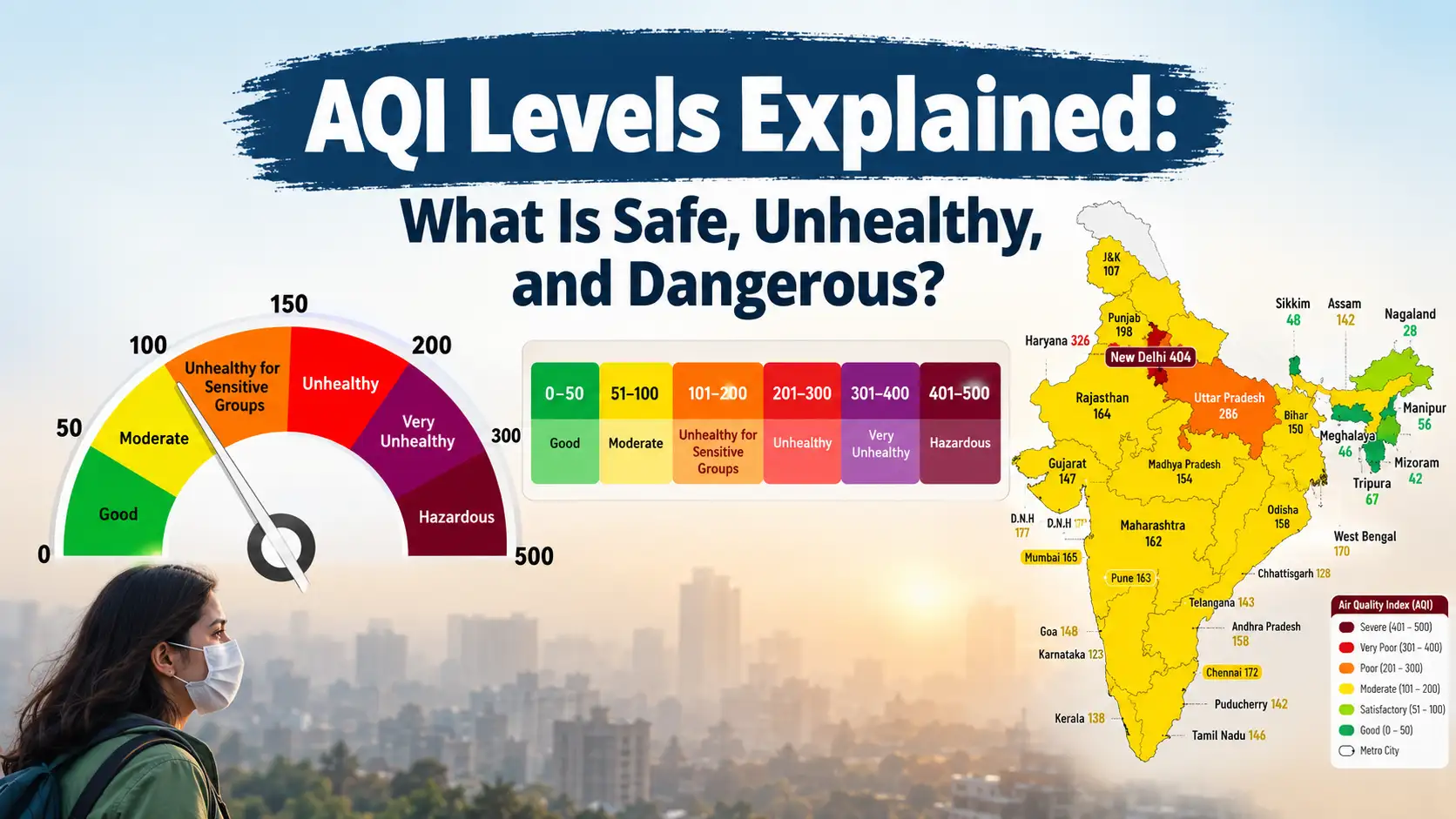
The Air Quality Index , or AQI , is a way to take complex pollution data and condense it into a single number that represents how clean the air is . The scale typically ranges from 0 to 500, with higher numbers indicating greater health concerns. Understanding different AQI levels helps people know when it’s okay to be outside. Especially when they might want to take precautions and when they should limit their exposure.
Air pollution can change a lot during the day and from place to place. Fine particulate matter (PM2.5), PM10, ozone, carbon monoxide, sulphur dioxide and nitrogen dioxide can all contribute to poor air quality. For people living in cities that have seasonal pollution, knowing the AQI categories is especially helpful for making daily decisions.
What Do the AQI Levels Mean?
AQI categories provide colour-coded ranges to make pollution levels easier to understand. Generally, an AQI of between 0 and 50 is considered good, while readings above 150 indicate air that can affect the health of the wider population.
AQI | Category | Colour | What It Means |
0–50 | Good | Green | Little or no health risk |
51–100 | Moderate | Yellow | Generally acceptable, but unusually sensitive people may notice effects |
101–150 | Unhealthy for Sensitive Groups | Orange | Sensitive groups may experience health effects |
151–200 | Unhealthy | Red | Everyone may begin experiencing health effects |
201–300 | Very Unhealthy | Purple | Increased risk of serious health effects |
301–500 | Hazardous | Maroon | Emergency conditions with serious risks for everyone |
These categories are consistent with the widely used US AQI. Local monitoring agencies can use different calculation methods or terminology, so readings should always be interpreted based on the system being reported.
What is a Safe AQI Level?
AQI from 0 to 50 is the safest range, and at this level, air quality is satisfactory and air pollution poses little or no risk.
For example, AQI 40 is in the Good range, which means normal outdoor activities, walking and exercise can usually be enjoyed without special air-quality precautions.
An AQI of 70 is considered Moderate. It remains acceptable for most, though persons with unusual sensitivity may feel a mild irritation, especially in long or strenuous outdoor activity.
AQI Example | What It Generally Means |
20 | Very good air quality |
40 | Good and generally safe |
70 | Acceptable for most people |
100 | Upper end of Moderate |
150 | Unhealthy for sensitive groups |
200 | Unhealthy for everyone |
300 | Very unhealthy |
500 | Hazardous |
When Does AQI Become Unhealthy?
At 101, the AQI is in the Unhealthy for Sensitive Groups range. Air pollution can be a bigger problem for children, older adults and those with existing heart or lung conditions.
At 151–200, air is considered unhealthy. The potential health impact is no longer limited to sensitive groups, and healthy people too can start showing symptoms such as coughing, throat or breathing discomfort, particularly after prolonged exposure.
AQI 201-300 is in very Unhealthy Conditions. Outdoor exposure should be minimised, particularly vigorous exercise that increases the volume of polluted air inhaled.
At AQI 300, the air is hazardous. This is an emergency-level situation in which the entire population may be at serious health risk.
Which pollutants influence the AQI?
AQI values are based on concentrations of major air pollutants. The pollutant with the highest health risk determines the reported AQI for a given location and time.
Pollutant | Common Sources | Potential Concern |
PM2.5 | Vehicle exhaust, combustion, smoke | Can penetrate deep into the lungs |
PM10 | Dust, construction, road particles | Can irritate the respiratory system |
Ozone (O₃) | Chemical reactions involving sunlight and pollutants | Can affect breathing |
Carbon Monoxide (CO) | Vehicle emissions and incomplete combustion | Reduces oxygen delivery in the body |
Sulphur Dioxide (SO₂) | Burning sulphur-containing fuels | Can irritate airways |
Nitrogen Dioxide (NO₂) | Vehicles and fuel combustion | Can irritate and inflame airways |
What People Should Do At Different AQI Levels?
The right response depends on the AQI, the pollutant, the length of exposure and individual health conditions.
AQI Range | Practical Approach |
0–50 | Normal outdoor activities are generally fine |
51–100 | Most people can continue normal activities; sensitive people can monitor symptoms |
101–150 | Sensitive groups should consider reducing prolonged or strenuous outdoor activity |
151–200 | Consider limiting prolonged outdoor exposure and heavy exercise |
201–300 | Reduce outdoor activity, particularly strenuous exercise |
301+ | Avoid outdoor exposure as much as possible and follow local health advisories |
On days with poor air quality, it can be useful to look up the current AQI when doing outdoor exercise to help prevent exposure to unnecessary levels of pollution. When pollution outdoors is particularly high, keeping windows shut and using suitable indoor air filtration can also help improve indoor air quality.
Does the AQI Differ By Location?
Not really. The AQI values are dependent on the calculation method and the pollutant concentration thresholds used by the appropriate monitoring authority. This holds particular importance when considering comparisons of readings from international platforms and official Indian monitoring data.
India’s official system for reporting air quality uses its own National Air Quality Index, but international platforms may show AQI figures calculated by different standards. This can sometimes result in differences in AQI values for the same pollution concentration across different platforms.
AQI should be interpreted with the source of the reading, the pollutant driving the score, and the health guidance provided by the relevant local authority, using good quality Air Purifiers can mitigate the threat.
FAQs
1. Is 40 AQI safe?
Yes. An AQI of 40 is in the Good range, from 0 to 50. Generally, this is regarded as satisfactory, and air pollution poses little or no risk.
2. Is an AQI of 70 okay?
AQI of 70 is in the moderate range. This is generally okay for most people, but may have a little effect on unusually sensitive people, especially if they are engaged in long periods of outdoor exercise.
3. When does air quality become unhealthy?
The commonly used US AQI scale sets air quality at Unhealthy for Sensitive Groups when it reaches 101, and Unhealthy for everyone at 151.
4. Is AQI 500 bad?
Yes. An AQI of 500 on the US AQI scale is within the Hazardous range. Such conditions are a serious health hazard and require minimising outdoor exposure and following official advisories.
5. Greater health risk always means higher AQI?
Typically, the higher the AQI, the greater the potential for health impacts. But the real impact can depend on the specific pollutant driving the AQI, how long you’re exposed, weather conditions, and your individual health.
Ad
Ad
Confused? Choose Your Phone
What Matters Most


Get TheWeekly Brief
One email each morning: the launches,
the price changes and the reviews
worth reading.

Ad
Ad
 |
|
807, 808, 8th Floor,
IRIS Tech Tower Sohna Road Sector 48,
Gurugram, Haryana - 122018