


- News
- All News
- Mobiles
- Laptops
- Watches
- Cameras
- Printers
- Refrigerators
- Televisions
- Air Conditioners
- Washing Machines
- Air Purifiers
- Water Purifiers
- Expert Reviews
- All Reviews
- Mobiles
- Laptops
- Watches
- Cameras
- Printers
- Refrigerators
- Televisions
- Air Conditioners
- Washing Machines
- Air Purifiers
- Water Purifiers
- Articles
- All Articles
- Mobiles
- Laptops
- Watches
- Cameras
- Printers
- Refrigerators
- Televisions
- Air Conditioners
- Washing Machines
- Air Purifiers
- Water Purifiers
- Videos
- Videos

Ad
LG OLED TVs in India: G4 Display Features, C-Series Differences and Samsung Tariff Investigation


on Google
on Google
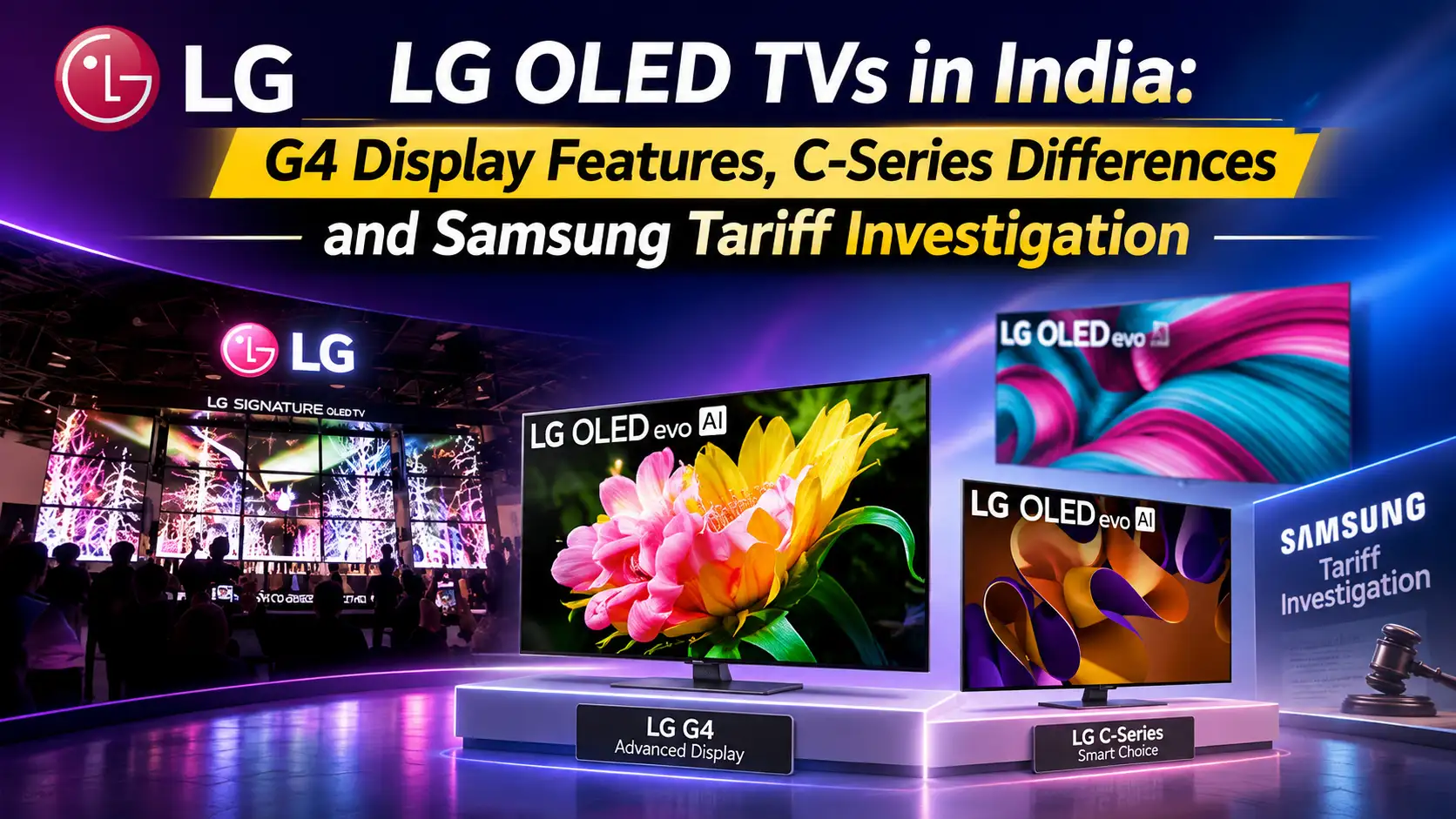
LG’s premium OLED TV range combines advanced display engineering with technologies to improve brightness, picture quality and gaming performance. The LG OLED55G4PSA, part of the company’s G4 OLED evo range, sits above the popular C-Series models and has Micro Lens Array (MLA) 2.0 technology, a dedicated heatsink and a more powerful processor.
What Makes the LG OLED55G4PSA Display Different From the C-Series?
The difference is particularly noticeable when watching HDR movies, high-quality streaming content and graphically demanding games, and the G4 has more vivid highlights and higher contrast for a more punchy image.
Why Does the G4 Have a Physical Heatsink?
The LG G4 also features a dedicated physical heatsink behind the OLED panel. That cooling hardware helps with the extra heat that comes with running the display at higher brightness levels.
This, together with the MLA technology, lets LG push the panel even further, while still managing the thermals. This helps the G4 hit its Brightness Booster Max performance, with peak brightness hitting around 1,500 nits in some test settings.
The C4 doesn't have the same dedicated heatsink setup and is usually capable of lower peak brightness, generally around 1,000 nits depending on the test window and picture settings.
LG OLED55G4PSA Vs C-Series: Key Display Differences
Feature | LG OLED55G4PSA (G4) | LG C-Series (C4) |
Panel technology | OLED evo with MLA 2.0 | OLED evo |
Dedicated heatsink | Yes | No |
Peak brightness | Up to approximately 1,500 nits | Around 1,000 nits |
Processor | α11 AI Processor 4K | α9 AI Processor 4K |
HDR performance | Higher brightness potential | Lower peak brightness |
Positioning | Premium flagship range | Mid-range OLED range |
Does the LG G4 Stay Bright While Playing Games?
The panel hardware of the G4 is also better for gaming. The α11 AI Processor 4K works in tandem with the display technology for image processing, HDR presentation and gaming features.
The C4 features the α9 AI Processor 4K, still able to deliver a great gaming experience. That said, if you're playing HDR content on a compatible game, the G4's higher brightness potential makes HDR highlights pop more.
What TV Has Better Glare And Viewing Angles?
Another aspect of how the G4 presents in different lighting situations is its use of an MLA-based panel. Neither TV is completely glare-free, but its light-management characteristics can help reduce the effects of some reflections.
Both models offer wide OLED viewing angles, allowing viewers to enjoy strong contrast and colour from positions away from the centre of the screen. Differences in colour appearance and reflections can still depend on room lighting and viewing position.
Overall, the G4's brighter output gives it an advantage in rooms where additional screen brightness is useful.
Why Is the DRI Looking Into LG And Samsung?
The central question is how to classify OLED open-cell panels, which are partially assembled glass display components used in the production of televisions, under customs law. Indian authorities are said to believe LG and Samsung used a preferential 5% import duty meant for some LCD and LED display components for OLED parts.
The DRI is of the view that there should be a 15% customs duty on OLED open-cell components instead of that. This difference creates a 10-percentage-point gap in the applicable tariff rate and can lead to additional tax liabilities if the authorities decide that the classification was incorrect.
Both companies are challenging the interpretation. Their argument, reportedly, is that OLED technology is an evolution of LED display technology and should be treated similarly regarding tariffs. The dispute therefore extends to the wider question of how newer display technologies are classified within India's customs framework, not just to the companies' individual imports.
Which LG And Samsung TV Products Are Involved?
The investigation concerns components used in premium OLED televisions rather than specific retail television models. Neither the reported investigation coverage nor the available details identify individual model numbers as being directly implicated.
The products involved can be understood through the following categories:
Product or component | Description |
LG OLED TVs | Premium televisions manufactured by LG using OLED display technology |
Samsung OLED TVs | Premium televisions manufactured by Samsung using OLED panels |
OLED open-cell panels | Imported glass display components at the centre of the tariff dispute |
LCD and LED TV components | Older display technology components associated with the existing 5% concessional tariff |
LG's OLED evo television range and Samsung's OLED television range represent the broader premium product categories affected by the classification debate. However, specific models, including individual OLED evo or Samsung S-series televisions, have not been identified as targets of the investigation.
The market is premium in its positioning, with a Made-in-India 65-inch Samsung OLED TV costing around ₹2 lakh, based on reported US-dollar equivalent and indicative conversion. This indicates the high-end segment involved rather than identifying a product under investigation.
What Action Have Indian Authorities Taken?
Separately, the DRI has reportedly initiated action to probe the import practices of the two manufacturers. Officials had visited Samsung's Indian headquarters in Gurugram to question company officials about imported OLED components and their customs classification.
Customs authorities have asked LG Electronics for written answers on its OLED imports. The company allegedly filed its responses and made a voluntary monetary deposit, the amount of which was undisclosed, to cover potential additional duty liabilities.
Samsung said it was reviewing the matter and was cooperating with the relevant authorities, while reiterating its commitment to comply with Indian laws. No final tax liability has been determined for either manufacturer as part of the investigation.
Will LG And Samsung Have To Pay Additional Penalties?
Penalties can be up to 100% of the alleged customs duty evaded, in addition to the tax amount due. Both the manufacturers would still have a legal right to challenge any final demands in the Indian judicial system.
The alleged duty shortfall has not been quantified and therefore at this stage it is not possible to quantify the potential financial impact.
Industry Groups Lobby For Changes To India OLED Tariff Rules
The probe also underscores a broader concern within India's electronics manufacturing industry. The Consumer Electronics and Appliances Manufacturers Association (CEAMA) and Manufacturers' Association for Information Technology (MAIT) have reportedly asked the government to extend the 5% concessional tariff to OLED display components.
Industry representatives say that manufacturers adopting newer display technologies will face higher input costs due to the exclusion of OLED parts. They also asked for exemptions on machinery used in making OLEDs to boost local investment.
The result could affect the cost structure of premium television manufacturing and future investments in India. LG and Samsung's immediate goal is to resolve the dispute on customs classification and to maintain their positions in the country's premium OLED television market.
Frequently Asked Questions
1. What is the difference between the LG OLED55G4PSA and the C4?
The G4 has the dedicated heatsink, α11 AI Processor and MLA 2.0 technology, whereas the C4 has a standard OLED evo panel and α9 processor.
2. How bright is the screen on the LG G4 OLED?
The G4 can hit around 1,500 nits of peak brightness under certain conditions, but results will vary with content and picture settings.
3. Between LG G4 vs C4 Gaming which is Good?
The G4 is brighter and has a more powerful chip. The C4 isn't too bad for gaming either, but doesn't quite pack the same punch.
4. Is the LG OLED55G4PSA a good replacement for the C-Series?
The G4 is a good consideration if you want more HDR brightness, premium panel engineering and better picture performance. For general viewing, the C-Series is likely better value.
Also Read
Ad
Ad
Confused? Choose Your Phone
What Matters Most


Get TheWeekly Brief
One email each morning: the launches,
the price changes and the reviews
worth reading.

Ad
Ad
 |

807, 808, 8th Floor,
IRIS Tech Tower Sohna Road Sector 48,
Gurugram, Haryana - 122018