


- News
- All News
- Mobiles
- Laptops
- Watches
- Cameras
- Printers
- Refrigerators
- Televisions
- Air Conditioners
- Washing Machines
- Air Purifiers
- Water Purifiers
- Expert Reviews
- All Reviews
- Mobiles
- Laptops
- Watches
- Cameras
- Printers
- Refrigerators
- Televisions
- Air Conditioners
- Washing Machines
- Air Purifiers
- Water Purifiers
- Articles
- All Articles
- Mobiles
- Laptops
- Watches
- Cameras
- Printers
- Refrigerators
- Televisions
- Air Conditioners
- Washing Machines
- Air Purifiers
- Water Purifiers
- Videos
- Videos

Ad
Sony Mirrorless vs DSLR in 2026: Which Camera Is Better?


on Google
on Google
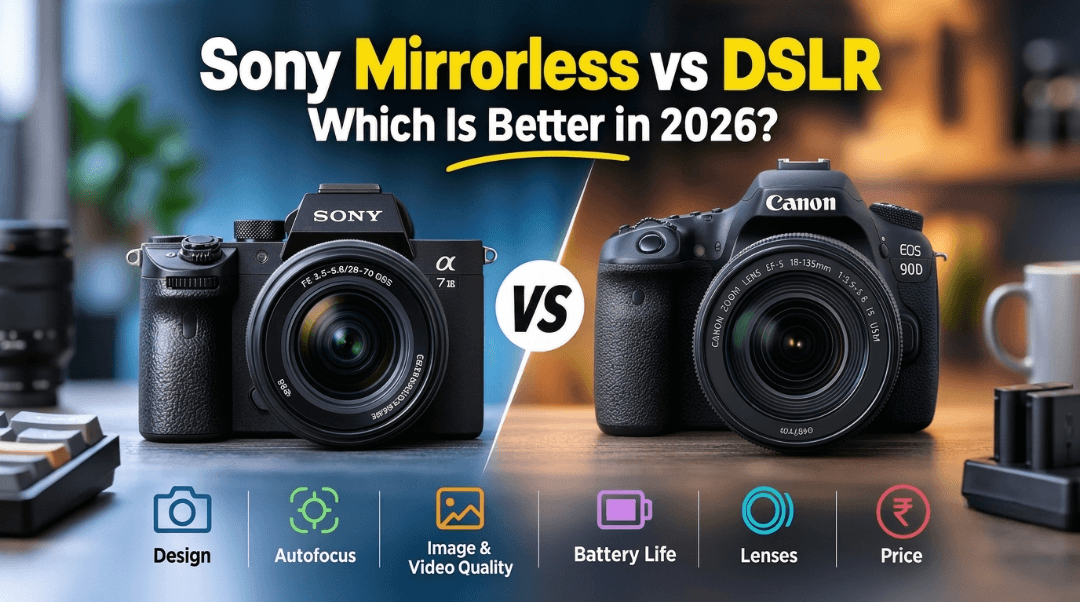
Choosing between a Sony mirrorless camera and a DSLR depends on your photography style, experience, budget and shooting requirements. Both camera types can capture high-quality photos, but they differ in autofocus performance, design, portability, viewfinders, battery life and lens options.
Sony has become a major name in mirrorless photography, offering cameras for beginners, professional photographers, vloggers and filmmakers. DSLR cameras, meanwhile, remain relevant for photographers who prefer optical viewfinders, traditional handling and access to a wide range of existing lenses.
So, which one should you choose in 2026? Let's compare Sony mirrorless cameras and DSLR cameras to understand their differences and find out which is better for your needs.
Sony Mirrorless vs DSLR: Key Differences
Feature | Sony Mirrorless | DSLR |
Design | Compact and lightweight | Generally larger and heavier |
Viewfinder | Electronic viewfinder (EVF) | Optical viewfinder (OVF) |
Autofocus | Advanced subject tracking and eye detection | Depends on model |
Video | Generally better video features | Varies by model |
Continuous shooting | Often faster, depending on model | Varies by model |
Battery life | Generally shorter | Often longer |
Lens selection | Growing native E-mount ecosystem | Extensive existing lens options |
Silent shooting | Electronic shutter available | Generally requires mechanical operation |
Image quality | Excellent | Excellent |
Best for | Photography, video and modern workflows | Traditional photography and existing DSLR users |
1. Design and Build Quality
Sony mirrorless cameras are smaller and lighter because they don't have the mirror mechanism found in DSLRs. This makes them easier to carry for travel and outdoor photography.
DSLRs are generally bigger and offer a deeper grip, which some photographers prefer for better handling.
Winner: Sony Mirrorless for portability.
2. Autofocus and Subject Tracking
Sony mirrorless cameras offer advanced autofocus features such as eye detection and real-time subject tracking. These are especially useful for capturing moving subjects, wildlife and sports.
DSLRs also offer reliable autofocus, but older models may struggle with tracking subjects in Live View and videos.
Winner: Sony Mirrorless for faster and smarter autofocus.
3. Image and Video Quality
Both camera types can capture excellent photos, depending on their sensor and lens quality.
However, Sony mirrorless cameras generally offer better video features, advanced autofocus and higher-resolution recording options. DSLRs can still deliver great results, but older models may lack these modern features.
Winner: Sony Mirrorless for video and hybrid content creation.
4. Electronic Viewfinder vs Optical Viewfinder
Sony mirrorless cameras use an Electronic Viewfinder (EVF), which shows a digital preview of the image. You can check exposure and other settings before taking a shot.
DSLRs use an Optical Viewfinder (OVF), allowing you to see the scene directly through the lens without a digital display.
Winner: Depends on preference. Mirrorless is better for real-time previews, while DSLR suits those who prefer an optical view.
5. Battery Life and Shooting Experience
DSLR cameras generally offer longer battery life because their optical viewfinders don't require continuous electronic power.
Sony mirrorless cameras use electronic displays and viewfinders, which consume more battery. Carrying an extra battery can be useful during long shoots.
Winner: DSLR for battery life.
6. Lens Availability and Compatibility
Sony mirrorless cameras use the E-mount system, which offers a wide range of lenses for portraits, wildlife, landscapes and everyday photography.
DSLR systems also have extensive lens collections, including affordable options in the second-hand market. Existing DSLR lenses can sometimes be used with mirrorless cameras through compatible adapters.
Winner: Draw. Both offer plenty of lens choices.
7. Price and Value for Money
DSLR cameras can be more affordable, especially if you are comfortable buying used equipment. They also offer access to many budget-friendly lenses.
Sony mirrorless cameras usually cost more, but provide newer autofocus, video and shooting features.
Winner: DSLR for budget buyers, while Sony mirrorless offers better value for those looking for modern features.
Which Is Better for Different Photography Needs?
Photography requirement | Better choice |
Beginner photography | Sony Mirrorless |
Wildlife photography | Sony Mirrorless |
Sports photography | Sony Mirrorless |
Travel photography | Sony Mirrorless |
Portrait photography | Both |
Wedding photography | Sony Mirrorless |
Professional video recording | Sony Mirrorless |
Traditional photography | DSLR |
Long battery life | DSLR |
Budget photography | Used DSLR |
Pros and Cons of Sony Mirrorless and DSLR Cameras
Sony Mirrorless Cameras
Pros
Compact and lightweight design.
Advanced eye autofocus and subject tracking.
Excellent video recording capabilities.
Electronic viewfinder with exposure preview.
Silent shooting options on supported models.
Modern features for professional photography.
Cons
Generally shorter battery life.
Professional bodies and lenses can be expensive.
Electronic viewfinder may not appeal to traditional photographers.
Electronic shutter can cause rolling-shutter distortion with fast-moving subjects on some models.
DSLR Cameras
Pros
Optical viewfinder provides a direct view of the scene.
Generally better battery endurance.
Wide availability of older and affordable lenses.
Comfortable handling and traditional camera controls.
Good value in the second-hand market.
Cons
Generally larger and heavier.
Fewer new camera models are being introduced.
Older models may have limited video capabilities.
Autofocus in Live View can be slower on some models.
Mirror mechanism adds mechanical complexity.
Frequently Asked Questions (FAQs)
1. Is Sony mirrorless better than DSLR for beginners?
Yes. Sony mirrorless cameras are generally better for beginners because they offer electronic viewfinders, real-time exposure previews and advanced autofocus features that make learning photography easier.
2. Do DSLR cameras take better pictures than Sony mirrorless cameras?
No. Neither camera type automatically produces better pictures. Image quality depends on sensor size, resolution, lens quality, image processing and photography skills.
3. Is a Sony mirrorless camera good for professional photography?
Yes. Sony's Alpha series includes professional full-frame cameras with advanced autofocus, high-resolution sensors and professional video features suitable for weddings, wildlife, portraits and commercial photography.
Also Read: Best Canon Mirrorless Cameras in 2026
Ad
Ad
Confused? Choose Your Phone
What Matters Most


Get TheWeekly Brief
One email each morning: the launches,
the price changes and the reviews
worth reading.

Ad
Ad
 |

807, 808, 8th Floor,
IRIS Tech Tower Sohna Road Sector 48,
Gurugram, Haryana - 122018