


- News
- All News
- Mobiles
- Laptops
- Watches
- Cameras
- Printers
- Refrigerators
- Televisions
- Air Conditioners
- Washing Machines
- Air Purifiers
- Water Purifiers
- Expert Reviews
- All Reviews
- Mobiles
- Laptops
- Watches
- Cameras
- Printers
- Refrigerators
- Televisions
- Air Conditioners
- Washing Machines
- Air Purifiers
- Water Purifiers
- Articles
- All Articles
- Mobiles
- Laptops
- Watches
- Cameras
- Printers
- Refrigerators
- Televisions
- Air Conditioners
- Washing Machines
- Air Purifiers
- Water Purifiers
- Videos
- Videos

Ad
Why Is a Whirlpool Washing Machine Not Draining or Completing a Cycle?


on Google
on Google
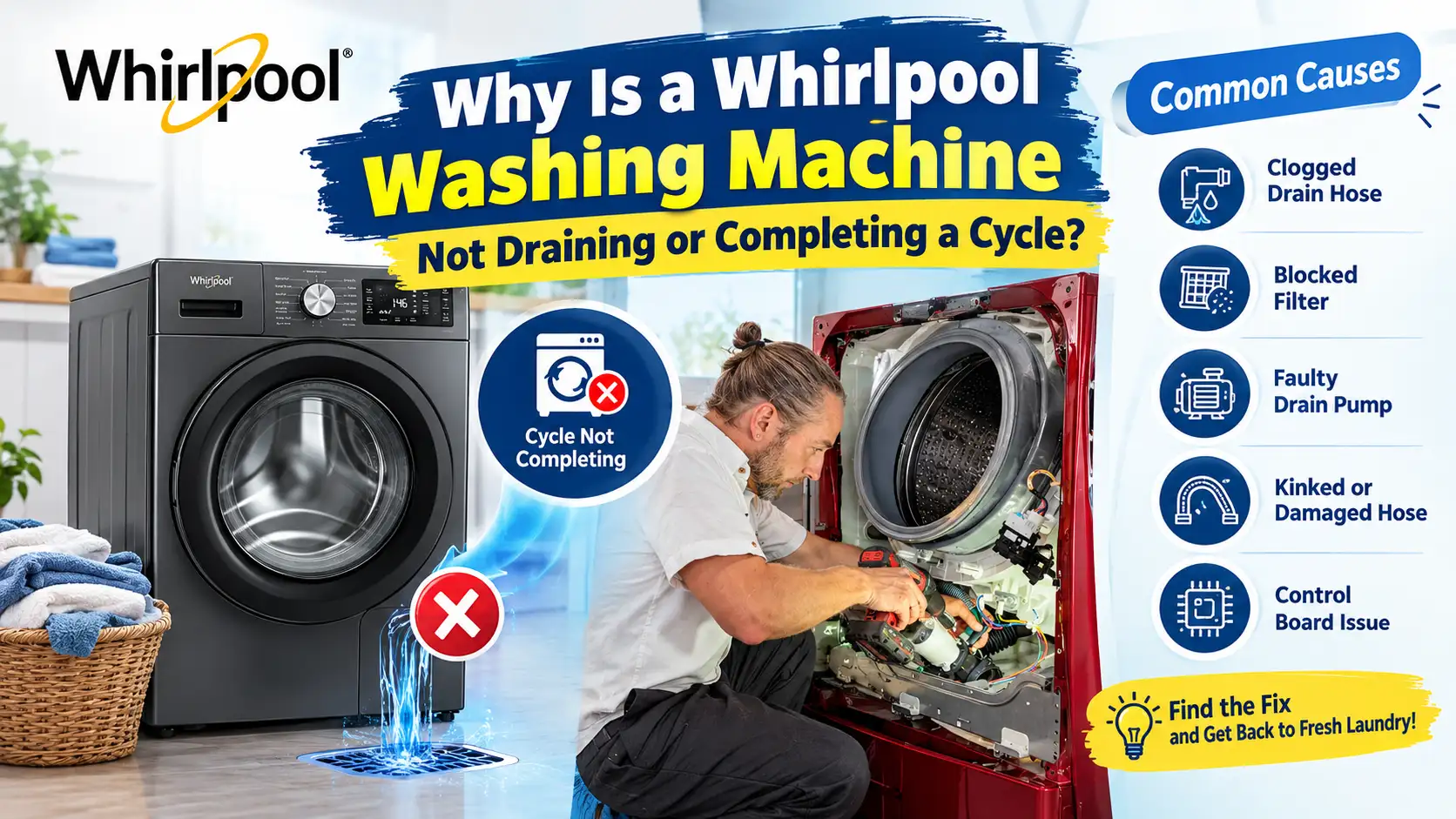
Whirlpool washing machine that stops mid-cycle, leaves water in the drum or refuses to complete a wash can disrupt everyday laundry routines. The problem may result from something as simple as a clogged drain filter or kinked hose, but it can also indicate a faulty drain pump, door lock or water-level sensor.
Common Reasons a Whirlpool Washing Machine Is Not Draining
The most frequent causes include blocked drainage components, excessive detergent, unbalanced loads and safety-lock problems. Mechanical or electrical faults may also prevent the washer from moving to the next stage of its cycle.
Possible cause | Common symptom | Suggested action |
Clogged drain filter | Water remains in the drum | Clean the filter if accessible |
Kinked or blocked drain hose | Slow or no drainage | Inspect and straighten the hose |
Faulty door or lid switch | Washer will not spin or advance | Check the door or lid closure |
Excessive suds or overloaded drum | Cycle pauses or takes longer | Reduce detergent or redistribute clothes |
Defective drain pump | Water remains despite a clear hose | Arrange pump inspection |
Water-level sensor or control fault | Cycle stalls unexpectedly | Seek professional diagnosis |
1. Check for a Clogged Drain Filter
A blocked drain filter is a common reason a washing machine cannot remove water effectively. Lint, coins, buttons and other small objects can collect in the filter or pump area, restricting water flow. Some front-load Whirlpool models have a user-accessible pump filter, while other models have different arrangements.
How to fix it:
Switch off and unplug the washing machine.
Consult the manual to locate the drain filter and confirm whether it is user-accessible.
Prepare towels and a shallow container to collect residual water.
Open the access panel and remove the filter according to the manufacturer's instructions.
Clear debris, clean the filter and reinstall it securely.
2. Inspect the Drain Hose for Kinks or Blockages
A bent, crushed or obstructed drain hose can prevent wastewater from leaving the washer. Incorrect hose positioning can also cause siphoning, in which water drains unexpectedly or the washer struggles to maintain the required water level.
How to fix it:
Check the hose behind the washing machine for bends or compression.
Inspect the visible hose outlet for blockages.
Confirm that the hose is installed at the height and insertion depth specified in the manual.
Ensure the household drain or standpipe is not blocked.
3. Check the Door Lock or Lid Switch
Whirlpool washing machines use safety mechanisms to confirm that the door or lid is closed before certain operations can begin. If the washer cannot detect a secure closure, it may refuse to spin, drain or proceed with the cycle.
How to fix it:
Check whether clothing is trapped between the door and its seal.
Close the door or lid firmly without slamming it.
Check for visible obstructions around the latch.
Look for a door-lock or lid-lock warning on the display.
4. Reduce Excessive Suds and Correct an Unbalanced Load
Using too much detergent can produce excessive suds, particularly when the detergent is unsuitable for the machine or the water conditions. Some washers may extend or interrupt parts of the cycle while attempting to manage the excess foam.
How to fix it:
Use the detergent type and quantity recommended for the washer.
Avoid adding extra detergent simply because clothes look particularly dirty.
Remove some items if the drum is overloaded.
Redistribute heavy garments, towels and bedding evenly.
Run the appropriate rinse or drain-and-spin programme if the manual permits it.
5. Investigate a Faulty Drain Pump or Water-Level Sensor
If the filter and hose are clear but water remains in the drum, the drain pump may be obstructed or defective. A foreign object can prevent the pump impeller from turning correctly, while a damaged motor or electrical connection may stop the pump from operating.
What to do:
Listen for unusual humming, grinding or repeated clicking during a drain attempt.
Check for a displayed error code and record it.
Stop using the machine if there is a burning smell, visible leakage or unusual electrical noise.
Arrange professional servicing if the pump, sensor or wiring appears to be faulty.
Troubleshooting Checklist and Error Codes
Before scheduling a repair, try these basic checks:
Switch off the washer and unplug it before inspecting accessible components.
Check the drain hose, household drain and accessible filter.
Confirm that the door or lid closes correctly.
Check the load size and detergent quantity.
Consult the manual for a model-specific reset procedure.
Record any error code before restarting the machine.
Front-Load vs Top-Load Whirlpool Washing Machines
Washer type | Common problem area | Recommended first check |
Front-load | Pump filter, drain hose or door lock | Check the accessible filter and door closure |
Top-load | Drain hose, lid lock or load balance | Check the hose, lid closure and load distribution |
When Should a Technician Be Called?
Professional servicing is advisable if the washer repeatedly fails to drain after the accessible filter and hose have been checked. A technician can inspect the pump, water-level sensor, wiring and control board to identify the underlying fault.
5 FAQs About Whirlpool Washing Machine Drainage Problems
1. Why is a Whirlpool washing machine full of water after a cycle?
A clogged filter, blocked drain hose, faulty pump or interrupted spin cycle can leave water in the drum. Check accessible drainage components first.
2. Why does a Whirlpool washer stop before completing a cycle?
Possible causes include excessive suds, an unbalanced load, a door-lock issue, drainage problems or a faulty sensor. The displayed error code can help narrow down the cause.
3. How can a Whirlpool washing machine be reset?
Many models can be reset by disconnecting power briefly, but the correct procedure varies. Follow the instructions for the specific model rather than relying on a universal button sequence.
Ad
Ad
Confused? Choose Your Phone
What Matters Most


Get TheWeekly Brief
One email each morning: the launches,
the price changes and the reviews
worth reading.

Ad
Ad
 |
|
807, 808, 8th Floor,
IRIS Tech Tower Sohna Road Sector 48,
Gurugram, Haryana - 122018