



Ad
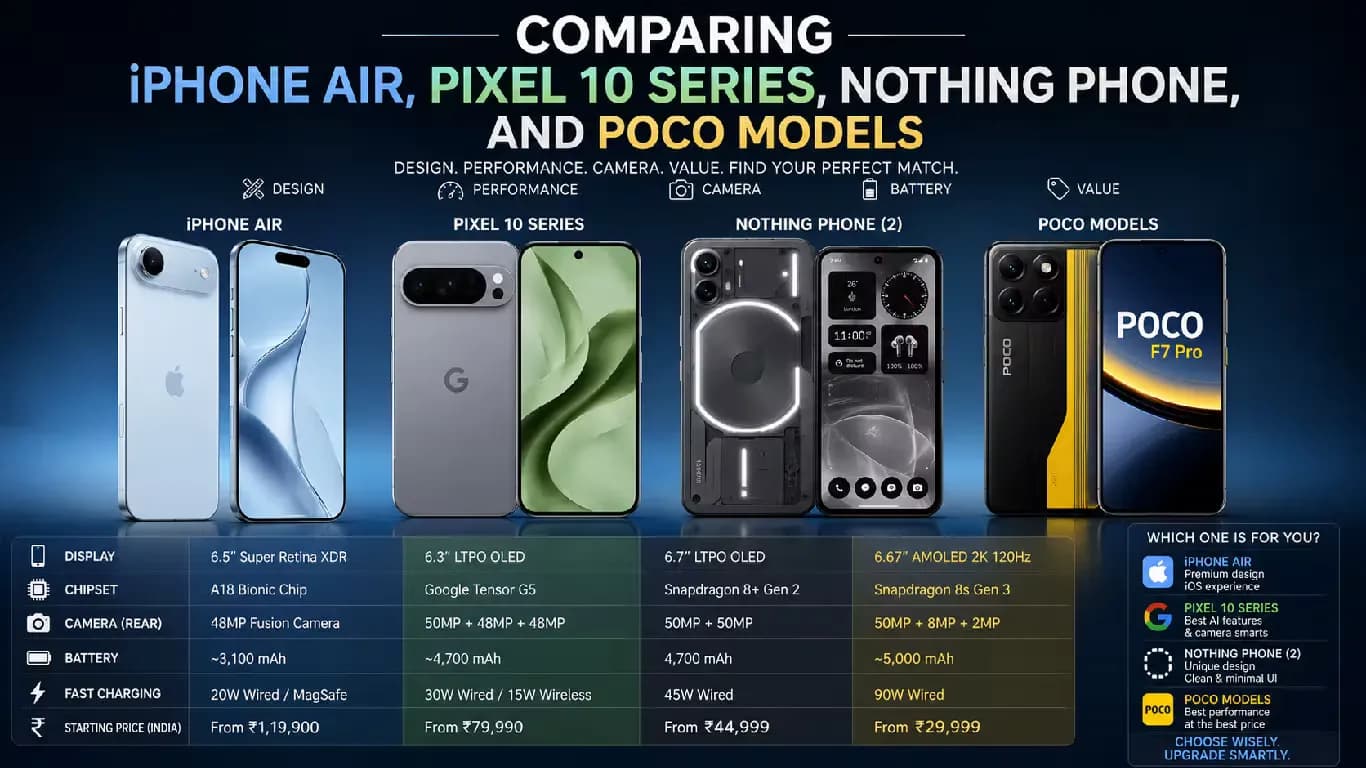
Comparing iPhone Air, Pixel 10 Series, Nothing Phone, and Poco Models



Follow Us:


7,119 views
Several new smartphones have entered the market, each offering different features, performance, and pricing. This overview compares the iPhone Air, Google Pixel 10 series, Nothing Phone models, and Poco devices, focusing on specifications and battery performance.
Key Highlights
- iPhone Air features a slim 5.6mm design and Apple A19 Pro chipset with a 12:44h use score.
- Pixel 10a offers the longest battery life among Pixel models with a 15:13h active use score.
- Nothing Phone (4b) is priced £80 less than the (4a) but has lower specs.
- Poco F8 Ultra includes Snapdragon 8 Elite Gen 5 and a 6,500mAh battery with 100W charging.
iPhone Air and Pixel 10 Series Overview
The iPhone Air stands out for its slim profile, measuring only 5.6mm thick and weighing 165g. Its titanium frame provides durability despite its thin design. The device features the Apple A19 Pro chipset and a 6.5-inch LTPO display. However, it has a single 48MP (1/1.56-inch) rear camera and a modest 3,149mAh battery. The iPhone Air achieved an Active Use Score of 12 hours and 44 minutes, indicating average endurance.
The Google Pixel 10 offers a smaller 6.3-inch screen, but it is thicker at 8.6mm and heavier at 204g. This allows for a larger 4,970mAh battery. Despite the bigger battery, the Pixel 10's Tensor G5 chipset is less efficient, resulting in an Active Use Score of 12 hours and 8 minutes. The Pixel 10a, another 6.3-inch model, uses the older Tensor G4 chipset. Its 5,100mAh battery delivers a longer Active Use Score of 15 hours and 13 minutes. However, the Pixel 10a lacks the Pixel 10’s 10.8MP 5x/112mm periscope camera.
Nothing Phone and Poco Model Comparisons
The Nothing Phone (4b) recently became available after a pre-order period. It is priced £80 less than the base 8/128GB Nothing Phone (4a). The (4a) model features a superior Snapdragon 7s Gen 4 chipset, UFS 3.1 storage, and better cameras, including a 50MP 3.5x/80mm periscope lens. Its 5,080mAh battery is comparable to the (4b)'s 5,200mAh battery. The Nothing Phone (3), which costs twice as much as the (4b), uses the Snapdragon 8s Gen 4 chipset and a 5,150mAh Si/C battery with 65W wired and 15W wireless charging. It includes a 50MP main camera with a 1/1.3-inch sensor, a 50MP 3x periscope, and a 50MP 114° ultra-wide camera.
The Poco F8 Pro offers a more affordable option with a faster Snapdragon 8 Elite chipset. It has a 6.59-inch 12-bit OLED display and a 6,210mAh battery supporting 100W wired charging. The camera setup includes a 50MP main camera (1/1.55-inch sensor), a 50MP 2.5x/60mm telephoto, and an 8MP 120° ultra-wide lens. For £30 more, the Poco F8 Ultra features the Snapdragon 8 Elite Gen 5 chipset, a 6.9-inch 12-bit OLED display, and a 6,500mAh battery with 100W wired and 50W wireless charging. Its cameras include a 50MP main (1/1.31-inch), a 50MP 5x/115mm periscope, and a 50MP ultra-wide.
The Poco X8 Pro is another alternative, powered by the Dimensity 8500 Ultra chipset and a 6,500mAh battery with 100W wired charging. It features a 6.59-inch 12-bit OLED display and a 50+8MP camera system. The Poco X8 Pro Max upgrades to a Dimensity 9500s chipset and an 8,500mAh Si/C battery, also with 100W wired charging. It has a larger 6.83-inch 12-bit OLED display but retains the same camera setup as the X8 Pro.
Latest News



Reviews & Guides
View All


Samsung Galaxy Buds 4 Pro Review: क्या ₹22,999 में मिलते हैं सबसे बेहतरीन प्रीमियम वायरलेस ईयरबड्स?

कंटेंट क्रिएटर के लिए सबसे दमदार बैटरी लाइफ वाले Windows लैपटॉप, 18 घंटे की मिलेगी बैटरी लाइफ

Samsung Galaxy S26 Ultra क्यों है साल का सबसे बेहतरीन स्मार्टफोन? जानें 5 बड़े कारण

MacBook Neo Review: सस्ता नहीं, Apple का मास्टरस्ट्रोक है ये Laptop!

Samsung Galaxy S26 Ultra Review: AI से लेकर प्राइवेसी डिस्प्ले है सबसे खास, जानें कैसी है परफॉरमेंस
Vivo V70 Elite Review 2026: Price in India, Specs, Features

OnePlus Campus Dominate Season 3 Concludes in Delhi NCR

Raksha Bandhan Special: 6 vivo Smartphones for Every Kind of Sibling

Acer Launches New Nitro 5 Series in india starting price of 167,990

Flipkart Freedom Sale 2026 Starts August 8 With Big Discounts on Smart TVs

Samsung has unveiled its first credit card, Earn 5% back

5 Anti-Scam Tools on WhatsApp that protect you from Digital Fraud