


- News
- All News
- Mobiles
- Laptops
- Watches
- Cameras
- Printers
- Refrigerators
- Televisions
- Air Conditioners
- Washing Machines
- Air Purifiers
- Water Purifiers
- Expert Reviews
- All Reviews
- Mobiles
- Laptops
- Watches
- Cameras
- Printers
- Refrigerators
- Televisions
- Air Conditioners
- Washing Machines
- Air Purifiers
- Water Purifiers
- Articles
- All Articles
- Mobiles
- Laptops
- Watches
- Cameras
- Printers
- Refrigerators
- Televisions
- Air Conditioners
- Washing Machines
- Air Purifiers
- Water Purifiers
- Videos
- Videos

Ad
Kent RO’s Premium Positioning Shapes India’s Water Purifier Market


on Google
on Google
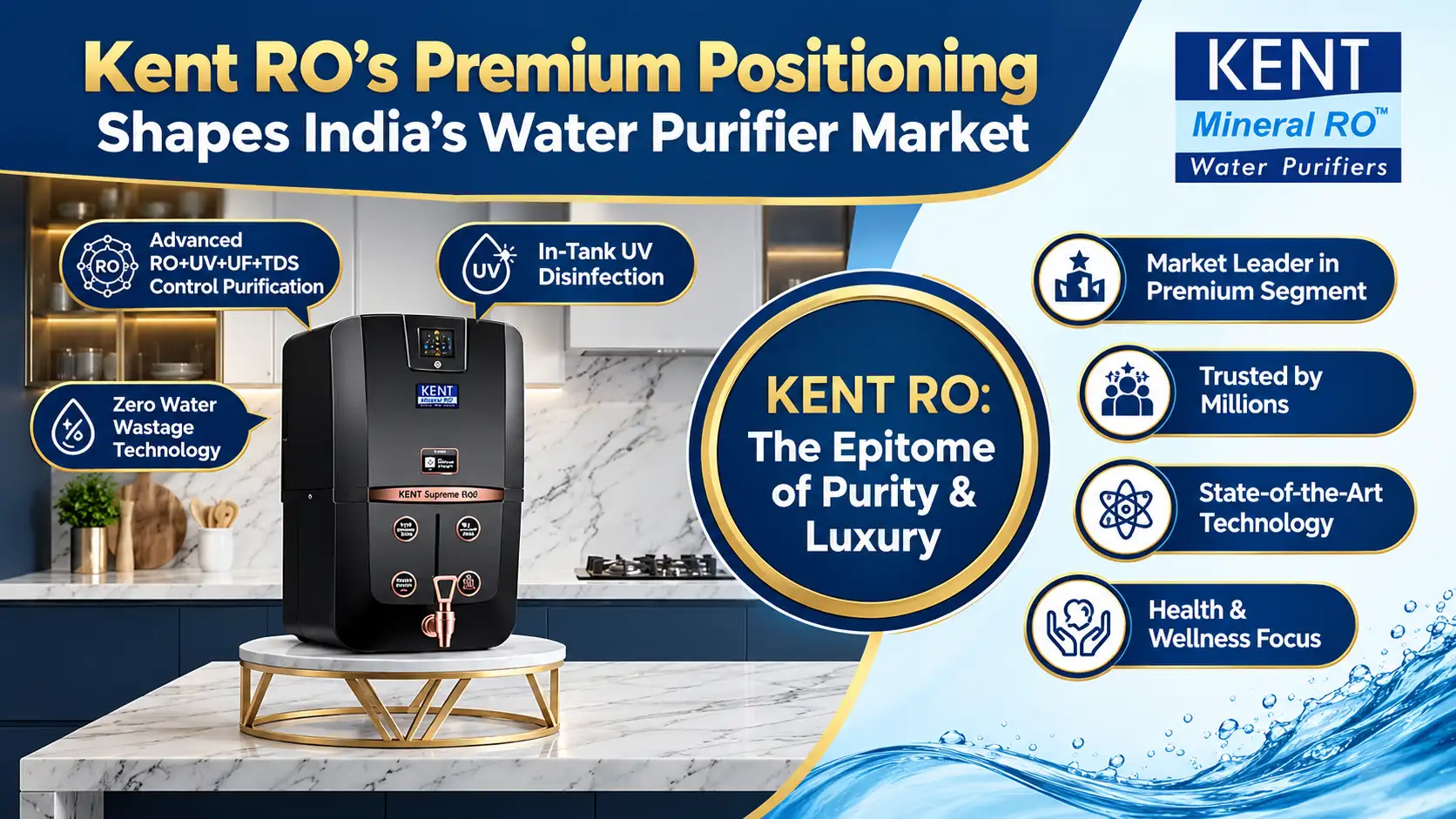
Kent’s DRHP for the proposed January 2025 offer for sale also emphasises more transparent disclosures of financials and operations; as the market matures, independent data on market share, consumer retention, and brand preference will increasingly matter in judging whether Kent’s premium positioning still delivers sustainable competitive strength.
Key Highlights:
In its early days, Kent’s brand was built around RO technology and premium pricing.
Celebrity endorsement, certifications, product innovation and service increased consumer trust.
Over 85% of revenue in FY24 was from water purifiers and softeners.
Kent RO developed premium positioning on RO technology
When UV purification was more established, and RO was relatively unfamiliar to consumers, Kent RO Systems entered India’s water purification market in 1999 with reverse osmosis (RO) technology. Founded by Mahesh Gupta and headquartered in Noida, the company started with a premium price point, with early RO purifiers costing around ₹20,000.
The strategy was more than product innovation. Kent had to teach the consumer about RO and build confidence in a relatively expensive home appliance. The business grew from 25 crore in 2005 to 600 crore in 2014, says Forbes India, pointing to the long-term role of brand building along with technology.
Trust and service were the basis of premium pricing
Kent’s premium positioning was supported by several levels of credibility. Hema Malini has been the face of the brand since 2006, giving the company a recognisable celebrity identity over a long period. The company also utilised television, print, digital, social media, sports sponsorship and e-commerce to boost its visibility.
Technical credibility was another part of the proposition. Kent’s products have been associated with certifications such as NSF/ANSI 58, while product development has included patented Mineral RO technology, non-electric purifiers, IoT-enabled devices and water-saving technologies.
After-sales service also became important because water purification is a recurring household requirement. Figures cited by Forbes India in 2014 included hundreds of franchised service centres and thousands of technicians, helping to support the premium proposition, according to company-reported figures.
Kent continues to focus its market position on RO
There was a lot more competition when Kent entered the category than there is today. In India, Eureka Forbes, Tata Chemicals, Panasonic, LG and HUL have entered the water purifier market at different points in time.
Forbes India had estimated Kent’s RO share at 30% in 2014, against 36% for Eureka Forbes in the RO segment. More recent figures of around 40% for Kent have been largely reported by the company and should be distinguished from independently verified market share data.
Kent has a strong footing in RO, but the difference in scale can be seen from the fact that Kent’s FY24 revenue was at ₹1,178 crore whereas Eureka Forbes’ revenue was at ₹2,189 crore as per Business Standard.
Advertising and distribution supported by brand strategy
Kent has continued to invest in building its brand. As per the figures mentioned in its draft red herring prospectus, advertising and business promotion expenses constituted 13.16% of revenue from operations in FY24. However, the six-month figure is not directly comparable with a full-year percentage, and the ratio increased to 20.23% in the six months to September 2024.
Distribution has also been key to the strategy. The DRHP summaries mentioned over 1,500 distributors and 10,000 dealers, a huge service network and growing online footprint. The company has manufacturing units at Noida and Roorkee, and its products are also sold in international markets.
Kent’s premium play in a shifting category
Kent’s experience shows how premium positioning can work when technology, trust and service reinforce one another. The company launched an expensive product, built awareness around RO, then added certifications, product innovation, and a wide distribution network.
Yet the strategy also poses challenges. Water purifiers and softeners accounted for 85.93% of revenue in FY24, keeping the business closely tied to its core category. At the same time, the rise of multiple competitors has made technology-led differentiation more difficult to sustain.
Ad
Ad
Confused? Choose Your Phone
What Matters Most


Get TheWeekly Brief
One email each morning: the launches,
the price changes and the reviews
worth reading.

Ad
Ad
 |
|
807, 808, 8th Floor,
IRIS Tech Tower Sohna Road Sector 48,
Gurugram, Haryana - 122018