


- News
- All News
- Mobiles
- Laptops
- Watches
- Cameras
- Printers
- Refrigerators
- Air Conditioners
- Washing Machines
- Air Purifiers
- Water Purifiers
- Expert Reviews
- All Reviews
- Mobiles
- Laptops
- Watches
- Cameras
- Printers
- Refrigerators
- Air Conditioners
- Washing Machines
- Air Purifiers
- Water Purifiers
- Articles
- All Articles
- Mobiles
- Laptops
- Watches
- Cameras
- Printers
- Refrigerators
- Air Conditioners
- Washing Machines
- Air Purifiers
- Water Purifiers
- Videos
- Videos

Ad
MIT Introduces Innovative Method for Training General-Purpose Robots Using Generative AI Techniques


The Massachusetts Institute of Technology (MIT) has made significant strides in the field of robotics by introducing a new training method that employs generative artificial intelligence (AI) techniques. This innovative approach focuses on unifying data from various domains and modalities, allowing robots to learn tasks more efficiently and effectively. By moving away from traditional training methods, MIT aims to pave the way for the development of general-purpose robots capable of performing a wide range of tasks without the need for extensive, task-specific training.
The Challenge of Robot Training
Training robots for specific tasks has historically been a complex and resource-intensive process. Conventional methods require vast amounts of simulation and real-world data to ensure that a robot can adapt to different environments and scenarios. Typically, for each new task, engineers must gather new datasets that encompass every possible situation the robot might encounter. This often leads to a lengthy training process, where robots are fine-tuned over time to optimize their performance and minimize errors.
Currently, many robots are trained for singular functions, resulting in limitations that prevent them from functioning as versatile, multi-purpose machines often depicted in science fiction. However, MIT's new technique offers a promising solution to this longstanding issue.
MIT's Groundbreaking Methodology
In a recent publication on the preprint platform arXiv, researchers at MIT detailed their novel approach to robot training, which seeks to harness the capabilities of generative AI. The method involves combining diverse datasets from different domains, such as simulation environments and real-world applications, into a coherent shared language that can be processed by large language models (LLMs).
Heterogeneous Pretrained Transformers (HPT)
At the core of this new approach is an architecture known as Heterogeneous Pretrained Transformers (HPT). This innovative design allows for the integration of varied data sources, including visual input from sensors and positional data from robotic arms. By establishing a shared language for these disparate data types, the HPT architecture enables more effective processing and understanding by AI models.
The lead author of the study, Lirui Wang, a graduate student in electrical engineering and computer science (EECS), noted that the inspiration for this approach came from existing AI models, particularly OpenAI's GPT-4. The integration of a transformer model into its system allows it to simultaneously process inputs related to vision and proprioception—the sense of self-movement, force, and position—creating a more holistic understanding of the environment.
Enhanced Efficiency and Cost-Effectiveness
The researchers claim that this new method can significantly reduce both the time and cost associated with training robots. By minimizing the need for extensive, task-specific datasets, this approach allows robots to learn multiple tasks more quickly. In their experiments, the researchers found that the new method outperformed traditional training techniques by over 20%, both in simulated environments and in real-world applications.
Implications for the Future of Robotics
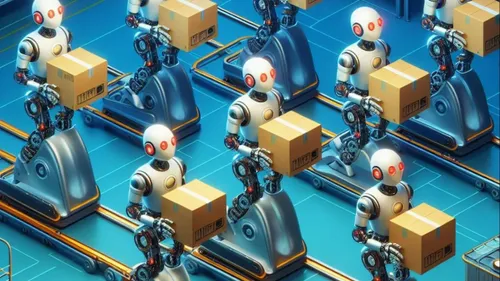
The implications of MIT's findings are profound. By enabling the development of general-purpose robots that can adapt to various tasks without extensive retraining, this technique could revolutionize the robotics industry. The potential applications are vast, ranging from manufacturing and logistics to healthcare and personal assistance.
With the ability to process data from different modalities and environments seamlessly, robots could be deployed in dynamic settings, adjusting their behavior based on real-time feedback and learning from diverse experiences. This capability would mark a significant advancement in creating robots that can operate in complex, unpredictable environments alongside humans.
A Step Toward Autonomous Learning
Furthermore, this method represents a step toward more autonomous learning systems. As robots become more adept at understanding and processing their surroundings, the prospect of creating machines that can independently acquire new skills becomes more tangible. This aligns with ongoing research into autonomous systems that can learn from experience, further bridging the gap between artificial intelligence and human-like cognitive abilities.
Way Forward
MIT's innovative method for training general-purpose robots using generative AI techniques is a groundbreaking development in the field of robotics. By leveraging the capabilities of large language models and the Heterogeneous Pretrained Transformers architecture, researchers are creating a pathway for robots that can learn and adapt more efficiently across a range of tasks. This advancement not only promises to enhance the functionality of robots in various industries but also opens the door to more autonomous and intelligent systems in the future. As technology continues to evolve, we may soon see robots that can navigate complex environments and perform diverse functions with minimal human intervention, transforming our interaction with technology.
Ad
Ad
Confused? Choose Your Phone
What Matters Most


Get TheWeekly Brief
One email each morning: the launches,
the price changes and the reviews
worth reading.

Ad
Ad
 |
|
807, 808, 8th Floor,
IRIS Tech Tower Sohna Road Sector 48,
Gurugram, Haryana - 122018