


- News
- All News
- Mobiles
- Laptops
- Watches
- Cameras
- Printers
- Refrigerators
- Televisions
- Air Conditioners
- Washing Machines
- Air Purifiers
- Water Purifiers
- Expert Reviews
- All Reviews
- Mobiles
- Laptops
- Watches
- Cameras
- Printers
- Refrigerators
- Televisions
- Air Conditioners
- Washing Machines
- Air Purifiers
- Water Purifiers
- Articles
- All Articles
- Mobiles
- Laptops
- Watches
- Cameras
- Printers
- Refrigerators
- Televisions
- Air Conditioners
- Washing Machines
- Air Purifiers
- Water Purifiers
- Videos
- Videos

Ad
Haier Triple Inverter AC vs Dual Inverter: Is the Upgrade Worth It?


on Google
on Google
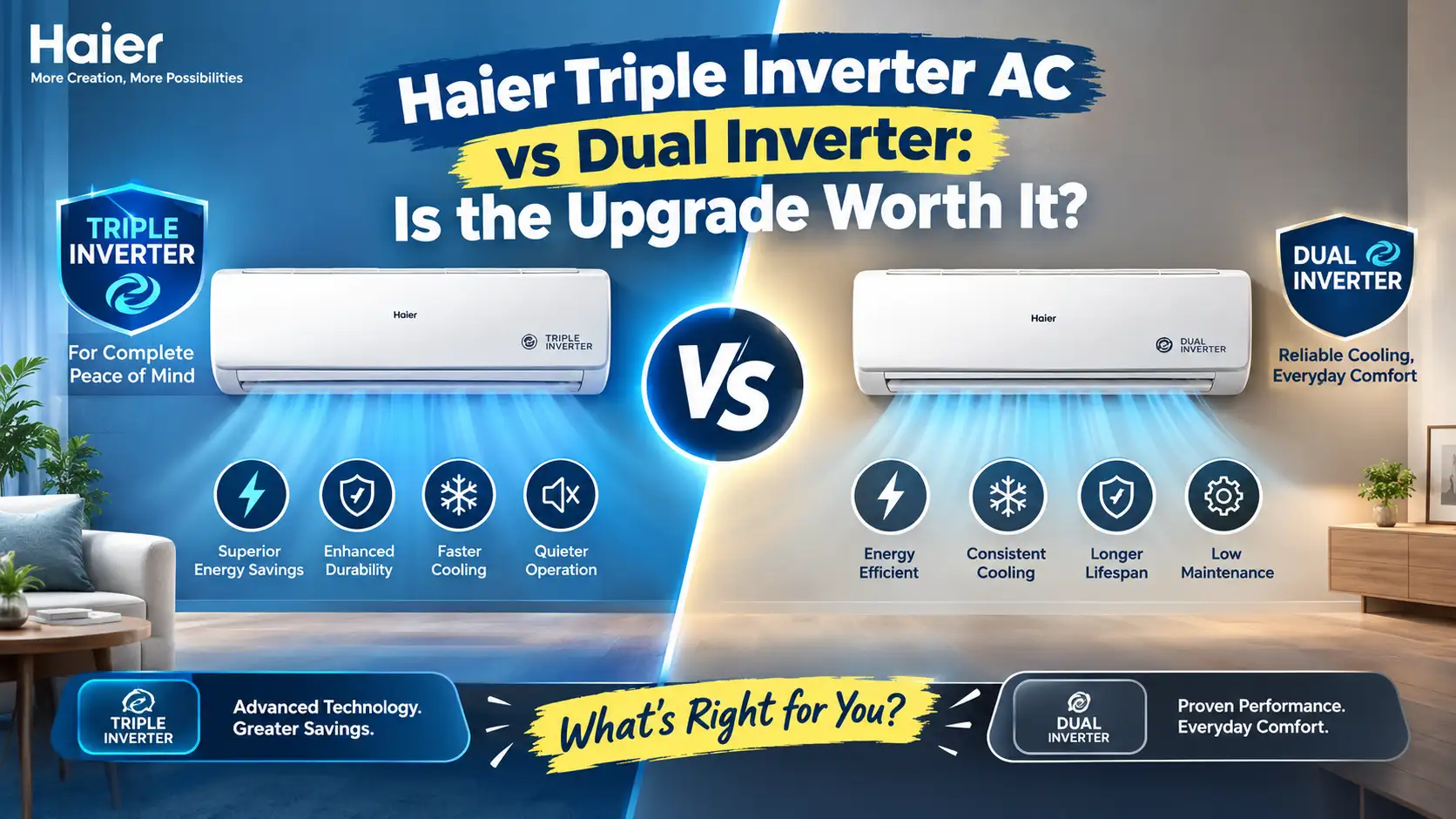
Choosing an air conditioner for Indian summers involves more than comparing tonnage and star ratings. Compressor technology, voltage stability, cooling capacity and electricity consumption all influence how effectively an AC performs during hot weather. Haier's Triple Inverter AC range promises enhanced compressor control and cooling performance, making it an option for households considering a new air conditioner.
However, does triple inverter technology offer a substantial advantage over dual inverter models, or is the difference primarily a branding distinction? The answer depends on the specific AC models being compared, the room's cooling requirements and the local climate. Understanding the technology and its practical benefits can help buyers decide whether paying extra makes sense.
What Is Haier Triple Inverter AC Technology?
Haier's Triple Inverter and Triple Inverter Plus branding refers to its approach to compressor and motor control, with features varying across product generations and models. Certain systems incorporate specialised DC control and variable-frequency operation to adjust cooling output according to demand.
Haier also offers convertible cooling modes on selected models, allowing users to adjust capacity according to occupancy and room conditions. Some models are advertised for operation in outdoor temperatures as high as 60°C, although this capability should be verified against the specific model's technical specifications.
A dual inverter AC typically uses inverter-driven compressor technology, often with a twin-rotary compressor design. It can vary compressor speed to maintain the target temperature rather than repeatedly switching between full power and complete shutdown.
The term triple inverter is not a universal industry standard that guarantees three separate inverters or a fixed level of performance improvement. Therefore, specifications, energy labels and tested performance are more useful comparison points than the technology name alone.
Haier Triple Inverter vs Dual Inverter: Key Differences
Feature | Haier Triple Inverter AC | Dual Inverter AC |
Compressor control | Advanced variable-frequency and DC control, depending on model | Variable-speed control, often using a twin-rotary compressor |
Cooling performance | Designed to deliver responsive cooling and stable operation | Offers efficient, consistent cooling when correctly sized |
Extreme heat | Selected models advertise operation at up to 60°C ambient temperature | Maximum operating temperature varies by model |
Voltage handling | Some models feature wide-voltage operation | Voltage tolerance varies by model |
Energy efficiency | Depends on model, usage and energy rating | Depends on model, usage and energy rating |
Price | Selected 1.5-ton models cost approximately ₹39,000–₹47,000 | Varies by brand, capacity and specifications |
The table highlights the intended differences, but it does not establish that every Haier Triple Inverter AC outperforms every dual inverter model. A model-to-model comparison is necessary to determine actual efficiency and cooling performance.
Does Triple Inverter Technology Cool Faster?
Haier's advanced compressor control is designed to adjust cooling output according to demand. This can help a room reach the desired temperature quickly, particularly when the AC has sufficient capacity for the room.
However, cooling speed also depends on room size, ceiling height, sunlight exposure, insulation and the number of occupants. A correctly sized dual inverter AC can outperform an undersized triple inverter model in a demanding room.
For households in regions experiencing extreme summer temperatures, checking the maximum rated outdoor operating temperature is particularly important. Haier's advertised 60°C capability may be useful where the specific model supports it, but it should not be assumed across the entire product range.
Which AC Offers Better Electricity Savings?
Both technologies can regulate compressor speed to match cooling demand, potentially reducing electricity consumption compared with conventional fixed-speed operation.
Haier advertises substantial potential energy savings for certain products, but such figures should not be treated as guaranteed household savings. Actual consumption depends on operating hours, selected temperature, room conditions and the model's rated efficiency.
Before purchasing, buyers should compare the following:
BEE star rating: Check the current energy label and its validity period.
Annual energy consumption: Compare the figures printed on the specific models' labels.
ISEER rating: A higher Indian Seasonal Energy Efficiency Ratio generally indicates better seasonal efficiency under the rating system.
Capacity: Choose suitable tonnage for the room instead of paying for unnecessary capacity.
A highly efficient dual inverter AC may offer better long-term value than a lower-efficiency triple inverter model.
Is Haier Triple Inverter AC Worth the Extra Price?
Selected Haier 1.5-ton, four-star and five-star Triple Inverter split ACs fall approximately in the ₹39,000–₹47,000 range, although prices vary by model, retailer and offers.
The additional investment may make sense for households that operate their AC for long hours, experience severe summer heat or need the particular voltage-handling and cooling features offered by a chosen model.
Household requirement | Suitability | Reason |
AC runs for long hours daily | Worth considering | Efficiency and sustained performance become more important |
Region experiences extreme summer heat | Worth considering | Certain models support high outdoor temperatures |
Frequent voltage fluctuations | Check model specifications | Wide-voltage operation may be beneficial |
Small bedroom with moderate cooling needs | Compare both technologies | A good dual inverter model may be sufficient |
Tight purchase budget | Compare total value | A less expensive, efficient dual inverter may cost less overall |
Lowest possible electricity bill | Compare BEE labels | Actual energy efficiency matters more than the inverter label alone |
Conversely, a good dual inverter AC may be sufficient for a moderately sized bedroom with ordinary cooling requirements. Installation quality, after-sales service, warranty terms and the availability of local technicians should also influence the decision.
5 FAQs About Haier Triple Inverter AC
1. Is Haier Triple Inverter AC better than Dual Inverter AC?
It can offer advantages in specific areas, depending on the model. However, triple inverter branding alone does not guarantee better cooling or lower electricity consumption.
2. Can Haier Triple Inverter AC work at 60°C?
Selected models advertise operation in outdoor temperatures up to 60°C. Buyers should verify the maximum operating temperature in the exact model's specifications.
3. Does Triple Inverter AC save more electricity?
Potentially, but actual savings depend on the AC's efficiency rating, room conditions, operating hours and temperature settings. Model-specific energy consumption is a better comparison metric.
4. What is the expected price of a Haier Triple Inverter AC in India?
Selected 1.5-ton, four-star and five-star models may cost approximately ₹39,000–₹47,000. Prices vary by specifications, retailer and availability.
5. Should buyers choose a Triple Inverter AC for a bedroom?
It can be suitable, particularly for long operating hours or demanding summer conditions. For a typical bedroom, a correctly sized, energy-efficient dual inverter AC may provide comparable practical value.
Final Verdict
Haier Triple Inverter AC technology offers features worth considering, especially for households that need high-temperature operation, responsive cooling and advanced compressor control. However, it is not automatically a major upgrade over a good dual inverter AC.
The most sensible choice is to compare exact models by BEE rating, annual electricity consumption, cooling capacity, maximum operating temperature and total purchase cost. These measurable specifications provide a more reliable basis for deciding whether the extra investment is worthwhile.
Ad
Ad
Confused? Choose Your Phone
What Matters Most


Get TheWeekly Brief
One email each morning: the launches,
the price changes and the reviews
worth reading.

Ad
Ad
 |
|
807, 808, 8th Floor,
IRIS Tech Tower Sohna Road Sector 48,
Gurugram, Haryana - 122018