


- News
- All News
- Mobiles
- Laptops
- Watches
- Cameras
- Printers
- Refrigerators
- Televisions
- Air Conditioners
- Washing Machines
- Air Purifiers
- Water Purifiers
- Expert Reviews
- All Reviews
- Mobiles
- Laptops
- Watches
- Cameras
- Printers
- Refrigerators
- Televisions
- Air Conditioners
- Washing Machines
- Air Purifiers
- Water Purifiers
- Articles
- All Articles
- Mobiles
- Laptops
- Watches
- Cameras
- Printers
- Refrigerators
- Televisions
- Air Conditioners
- Washing Machines
- Air Purifiers
- Water Purifiers
- Videos
- Videos

Ad
Frost-Free vs. Direct Cool Refrigerator: Which to Buy?


on Google
on Google
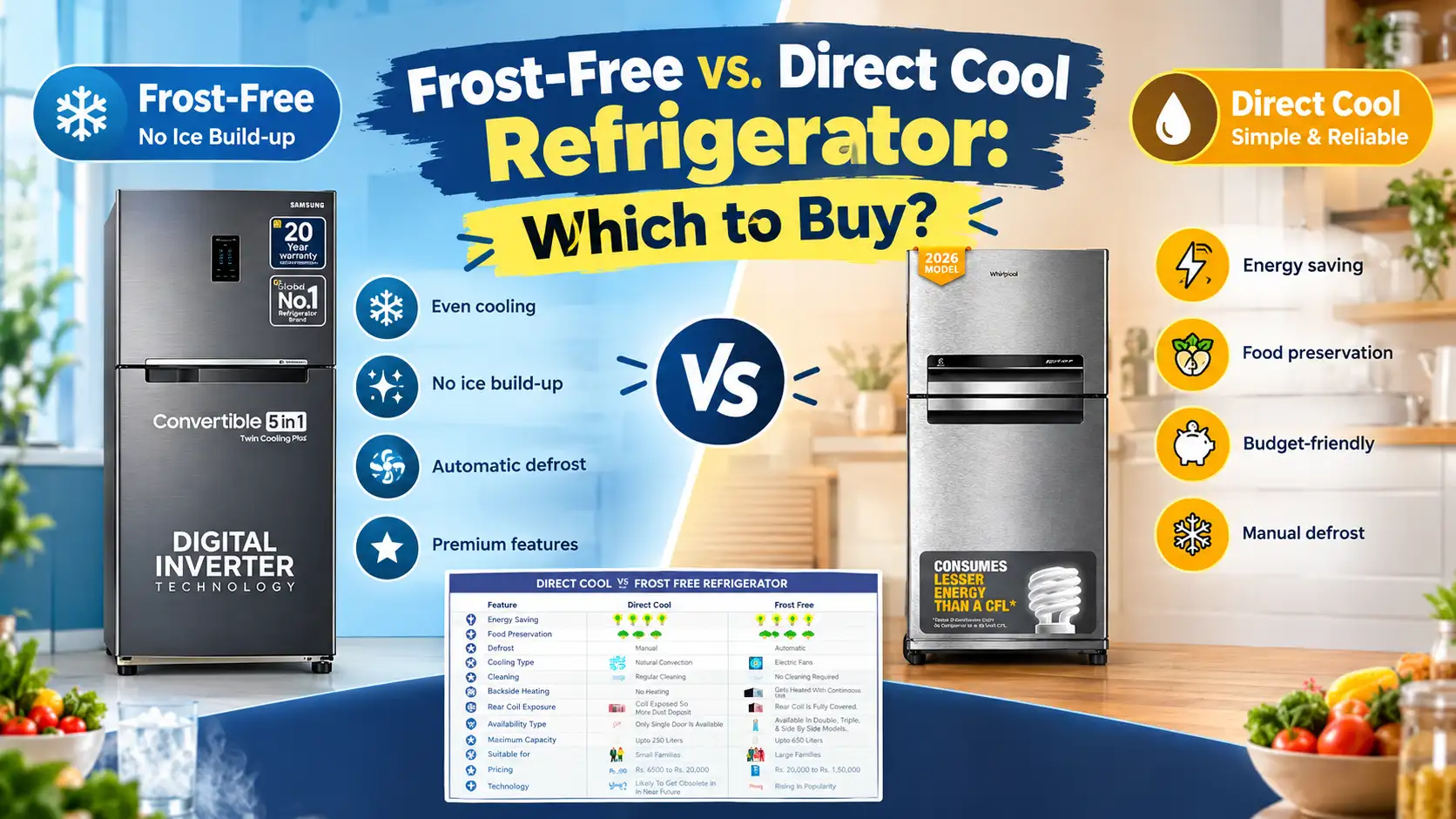
Choosing a refrigerator is no longer simply about picking the biggest model available. The cooling technology can affect the purchase price, electricity consumption, maintenance and everyday convenience. Two common options in the Indian market are Direct Cool and Frost-Free refrigerators, but their differences can make one more suitable than the other depending on household size and usage.
Direct Cool models are generally simpler and more affordable, while Frost-Free refrigerators offer automatic defrosting and more consistent cooling. Understanding how both technologies work can make it easier to decide where the extra money, if any, is worth spending.
Direct Cool vs Frost-Free Refrigerator: Key Differences
The fundamental difference is how each refrigerator circulates cold air and manages frost. Direct Cool refrigerators depend largely on natural convection, while Frost-Free models use fans to circulate cold air throughout the compartments.
Feature | Direct Cool | Frost-Free |
Cooling | Natural convection | Fan-assisted air circulation |
Defrosting | Manual | Automatic |
Frost build-up | Possible | Significantly reduced |
Initial price | Generally lower | Generally higher |
Electricity use | Usually lower | Usually slightly higher |
Typical design | Mostly single-door | Double-door and multi-door options |
Capacity | Often smaller | Available in larger capacities |
Ideal for | 1–3 people | 3+ people and larger households |
How Does a Direct Cool Refrigerator Work?
The freezer section can gradually develop ice, particularly when the refrigerator is opened frequently or operates in humid conditions. Depending on the model, users may need to press a defrost button or switch off the appliance periodically to remove accumulated frost.
What Makes Frost-Free Refrigerators Different?
Frost-Free refrigerators use an electric fan to circulate chilled air through the refrigerator and freezer compartments. Active air circulation helps distribute cooling more consistently across shelves and storage areas, making the technology suitable for larger refrigerators.
This convenience can be particularly useful for households that use the refrigerator heavily. Frost-Free technology is also commonly found in larger double-door, convertible and multi-door refrigerators, giving families more space for fresh food, frozen products and bulk grocery storage.
Direct Cool vs Frost-Free: Price and Power Consumption
Price and electricity consumption are two important factors to consider before choosing between the technologies. Direct Cool refrigerators are generally positioned towards the more affordable end of the market, while Frost-Free models usually command a higher price because of their additional cooling and defrosting technology.
Factor | Direct Cool | Frost-Free |
Initial cost | Generally lower | Generally higher |
Electricity use | Usually lower | Usually slightly higher |
Defrosting system | Manual | Automatic |
Cooling technology | Natural convection | Fan-assisted |
Long-term running cost | Can be economical | Depends on model and usage |
Best for | Budget-conscious buyers | Convenience-focused buyers |
Which Refrigerator Is Better for a Small Family?
For one to three people, a Direct Cool refrigerator can be a practical choice when storage requirements are modest. A smaller single-door model can provide enough room for everyday groceries, beverages, vegetables and other essentials without requiring the higher investment associated with a larger Frost-Free appliance.
The trade-off is manual defrosting. Ice accumulation can reduce usable freezer space and requires occasional maintenance.
For a small family that wants greater convenience, a compact Frost-Free model can still be considered. The decision ultimately comes down to whether automatic defrosting and more uniform cooling justify the additional purchase cost.
Which Refrigerator Is Better for Larger Families?
For households with three or more members, a Frost-Free refrigerator is often more suitable because larger capacities and double-door configurations provide greater flexibility.
The fan-assisted system can distribute cold air more evenly, while automatic defrosting eliminates one of the most inconvenient maintenance tasks associated with Direct Cool refrigerators.
Frost-Free models can also be useful for households that shop in bulk or regularly store prepared food, frozen items and larger quantities of fresh produce. Their larger layouts make it easier to separate different categories of food.
Which Brands Offer Direct Cool and Frost-Free Refrigerators?
Brands such as LG, Haier and Samsung offer refrigerator options across different capacities, budgets and cooling technologies.
For example, LG and Samsung offer Frost-Free double-door refrigerators with features designed for convenient food storage, while Haier offers both Direct Cool and Frost-Free models for different household requirements.
Before purchasing, it is worth comparing the specific model’s capacity, energy rating, cooling features, warranty and price rather than relying on the brand name alone.
Frost-Free vs Direct Cool: Which Should You Buy?
The choice depends primarily on household size, budget and convenience.
Choose Direct Cool if... | Choose Frost-Free if... |
Budget is the main concern | Convenience is a priority |
Household has 1–3 people | Household has 3+ people |
Smaller capacity is sufficient | More storage space is required |
Lower electricity consumption is preferred | More consistent cooling is preferred |
Manual defrosting is acceptable | Manual defrosting is undesirable |
Simple refrigerator design is preferred | Double-door or multi-door design is needed |
A Direct Cool refrigerator makes sense for buyers who want an economical appliance for basic daily storage and do not mind occasional defrosting.
A Frost-Free refrigerator is more appropriate for buyers who value convenience, need more storage space and want automatic defrosting with active air circulation.
Ultimately, neither technology is universally suitable for every household. A single person with limited storage needs may find Direct Cool sufficient, while a larger family that frequently stores groceries may benefit from the additional capacity and convenience of Frost-Free technology.
FAQs
Is Frost-Free better than Direct Cool?
Frost-Free is more convenient because it automatically manages frost and actively circulates cold air. Direct Cool can be more economical for smaller households and budget-conscious buyers.
Does Direct Cool consume less electricity?
Direct Cool refrigerators generally use less electricity than comparable Frost-Free models because they do not require powered fans and automatic defrosting components. Actual consumption varies by model and energy rating.
Does a Frost-Free refrigerator need manual defrosting?
No. Frost-Free refrigerators are designed to automatically manage frost accumulation, so routine manual defrosting is generally unnecessary.
Ad
Ad
Confused? Choose Your Phone
What Matters Most


Get TheWeekly Brief
One email each morning: the launches,
the price changes and the reviews
worth reading.

Ad
Ad
 |
|
807, 808, 8th Floor,
IRIS Tech Tower Sohna Road Sector 48,
Gurugram, Haryana - 122018