


- News
- All News
- Mobiles
- Laptops
- Watches
- Cameras
- Printers
- Refrigerators
- Televisions
- Air Conditioners
- Washing Machines
- Air Purifiers
- Water Purifiers
- Expert Reviews
- All Reviews
- Mobiles
- Laptops
- Watches
- Cameras
- Printers
- Refrigerators
- Televisions
- Air Conditioners
- Washing Machines
- Air Purifiers
- Water Purifiers
- Articles
- All Articles
- Mobiles
- Laptops
- Watches
- Cameras
- Printers
- Refrigerators
- Televisions
- Air Conditioners
- Washing Machines
- Air Purifiers
- Water Purifiers
- Videos
- Videos

Ad
AI Supply Chain Exposure Splits Q3 Outlook for Samsung, LG Parts Units


on Google
on Google
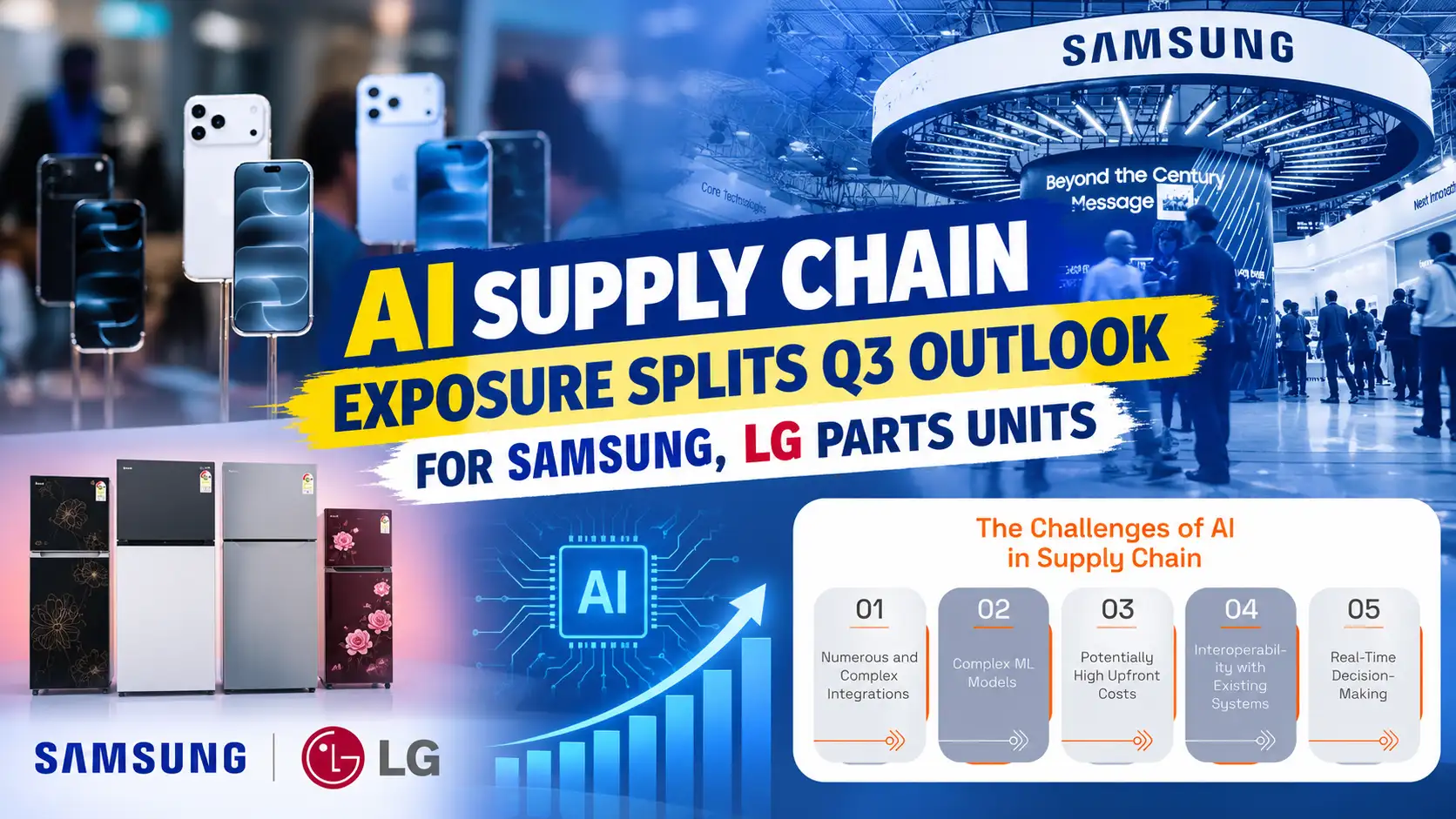
South Korean electronics component makers LG Innotek and Samsung Electro-Mechanics are facing very different earnings outlooks as demand for artificial intelligence (AI) soars. LG Innotek is feeling the pain of a decline in profit outlook amid currency volatility and uncertainty on demand for smartphone components, while Samsung Electro-Mechanics is riding the wave of growing demand for AI server components, multilayer ceramic capacitors (MLCC) and semiconductor substrates, and the split illustrates how companies’ third-quarter outlooks are being influenced by product diversification and exposure to AI infrastructure.
Key Highlights
LG Innotek's consensus operating profit estimate for the third quarter dropped 32.8% to around ₹1,680 crore, hurt by currency pressures and concerns about iPhone component demand.
Samsung Electro-Mechanics’ operating profit estimate rose 6.2% to about Rs 5,320 crore on high-value components and semiconductor substrates.
Samsung Electro-Mechanics has bagged six long-term MLCC supply contracts for 2026 with total orders of about ₹32,300 crore.
Samsung, LG earnings outlook split on AI supply chain exposure
South Korean electronics component makers LG Innotek and Samsung Electro-Mechanics are seeing divergent earnings expectations for the third quarter as they have varying exposure to the artificial intelligence (AI) supply chain. LG Innotek is grappling with declining profit estimates amid currency fluctuations and concerns over demand for smartphones, while Samsung Electro-Mechanics is riding the crest of demand for multilayer ceramic capacitors (MLCCs) and semiconductor substrates.
The divergence underscores the impact of product diversification and exposure to AI-related infrastructure on the profitability of the global electronics industry, and AI data centres need more complex components and more power capacity, so there are more growth opportunities for manufacturers supplying these markets.
Broking consensus estimates for the two companies diverged in the month leading up to Oct. 13, 2026, according to market tracker FnGuide.
LG Innotek under pressure over currency and iPhone worries
LG Innotek’s consensus operating profit estimate for the third quarter dropped 32.8 per cent to 202.9 billion won from 302 billion won a month earlier. The revised estimate is around ₹1,258 crore as against earlier estimate of around ₹1,872 crore, assuming an indicative exchange rate of ₹62 per South Korean won.
Revenue forecasts were also slashed to 6.1 trillion won from 6.32 trillion won. The outlook is deteriorating, the report said, with shares of LG Innotek down 15.47 per cent on Monday.
Foreign exchange fluctuations are a big concern. The stronger currency conditions now are playing out in the sales of materials and inventories that were made when the Korean won was weaker, and that’s putting pressure on profit margins.
Kiwoom Securities analyst Kwon Min-kyu said the pressure came from the timing of component shipments and the sharp movement in exchange rates. The impact has been magnified by LG Innotek’s heavy dependence on overseas sales and raw material prices.
Kwon expects operating profit for the third quarter to be 91.7 billion won, down 55 percent from a year earlier.
The company’s business mix adds to its vulnerability. LG Innotek earns more than 80% of its revenue from optical solutions, and it is heavily reliant on large device makers such as Apple.
The iPhone 18 Pro series features higher resolution cameras and variable apertures, which could increase the value of camera modules, but demand remains uncertain. Some suppliers have been asked to cut production of components for the iPhone 18 series, amid rising chip costs and worries about consumer demand, a Nikkei report cited by the original article said.
Samsung Electro-Mechanics enjoys AI component demand
Samsung Electro-Mechanics raised its earnings outlook. The consensus estimate for third-quarter operating profit was up 6.2% to 642.3 billion won compared with 605 billion won a month ago. This works out to be about ₹3,982 crore at the indicative exchange rate.
Compared to LG Innotek, Samsung Electro-Mechanics has a more balanced revenue structure, with electronic components, semiconductor substrates and optical communication solutions.
The diversified portfolio provides better resilience to currency fluctuations and allows the company to capitalise on the increasing demand for advanced electronic components.
Earnings in the component and package solution businesses are expected to be supported by higher-value products and price hikes, said DS Securities analyst Cho Dae-hyung.
Long-Term MLCC Contracts Improve Samsung’s Growth Outlook
Another positive factor is the growing list of long-term supply agreements for Samsung Electro-Mechanics. The company secured its sixth MLCC contract in 2026, bringing the total value of such orders to 3.9 trillion won, or approximately ₹24,180 crore at the illustrative exchange rate.
The reported order value is greater than one-third of the company’s total revenue last year, demonstrating the growing importance of such contracts.
MLCCs temporarily store electrical energy and provide stable power to semiconductors as needed, and with AI servers requiring more electricity and depending on complicated electronic systems, their significance increases.
The divergent perspectives suggest that being in the AI supply chain alone does not guarantee better profits. Product diversification, customer demand, cost structures and currency exposure continue to be important factors.
Samsung Electro-Mechanics’ profit prospects are being driven by demand for AI-driven components and long-term contracts. LG Innotek, meanwhile, is facing exchange-rate pressures and uncertainty over its optical business, which is dependent on smartphones.
Ad
Ad
Confused? Choose Your Phone
What Matters Most


Get TheWeekly Brief
One email each morning: the launches,
the price changes and the reviews
worth reading.

Ad
Ad
 |
|
807, 808, 8th Floor,
IRIS Tech Tower Sohna Road Sector 48,
Gurugram, Haryana - 122018