


- News
- All News
- Mobiles
- Laptops
- Watches
- Cameras
- Printers
- Refrigerators
- Televisions
- Air Conditioners
- Washing Machines
- Air Purifiers
- Water Purifiers
- Expert Reviews
- All Reviews
- Mobiles
- Laptops
- Watches
- Cameras
- Printers
- Refrigerators
- Televisions
- Air Conditioners
- Washing Machines
- Air Purifiers
- Water Purifiers
- Articles
- All Articles
- Mobiles
- Laptops
- Watches
- Cameras
- Printers
- Refrigerators
- Televisions
- Air Conditioners
- Washing Machines
- Air Purifiers
- Water Purifiers
- Videos
- Videos

Ad
Fridge Not Cooling, But Freezer Works? Causes and Fixes


on Google
on Google
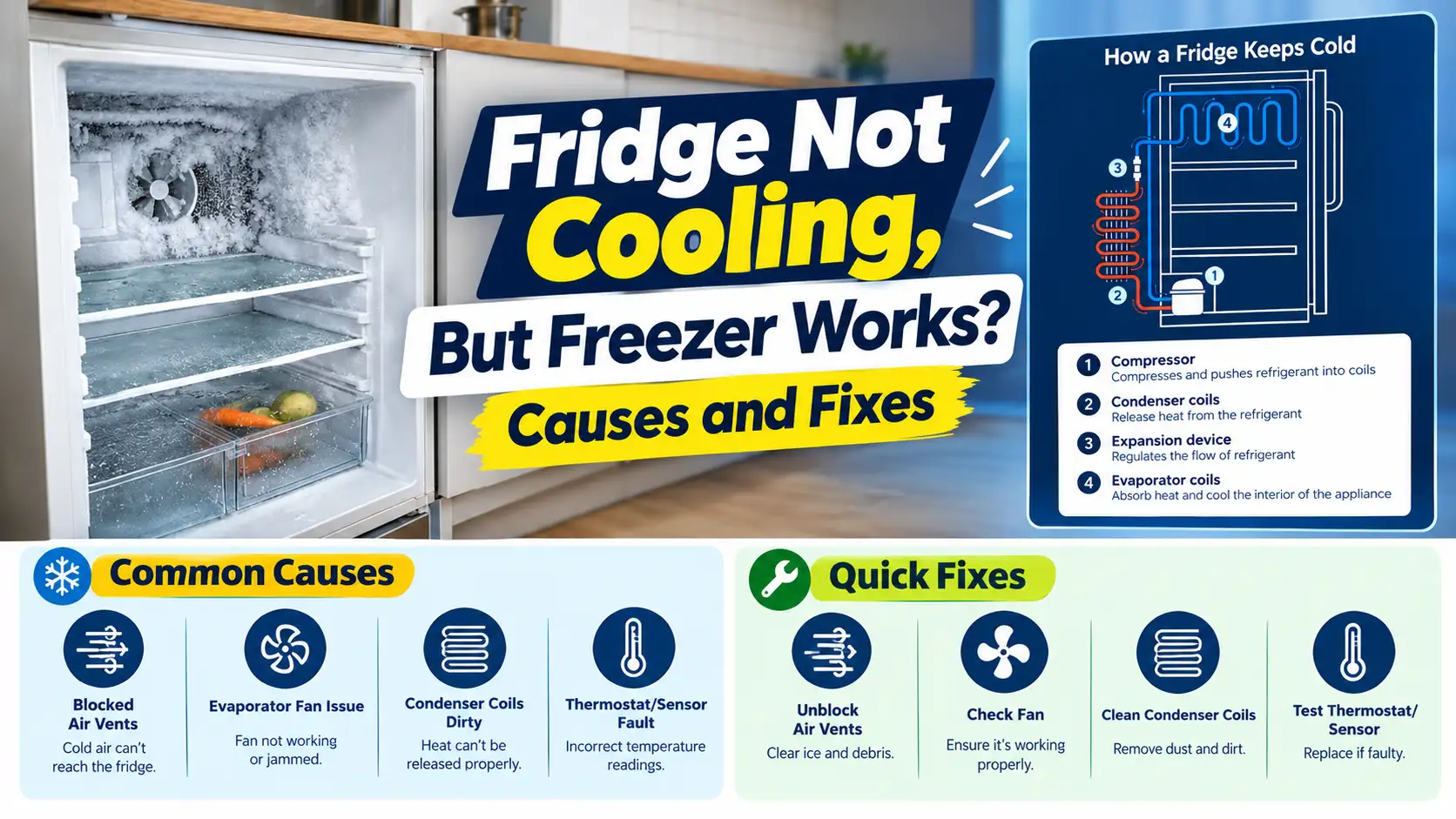
A refrigerator that is not cooling while its freezer continues to work can be confusing, especially when the freezer appears to be operating normally. In most cases, the refrigerator and freezer share the same cooling system, but cold air must circulate from the freezer into the fresh-food compartment. If that airflow is blocked or a related component fails, the freezer may remain cold while the fridge becomes warm.
Before calling a technician, several simple checks can help identify the problem. Blocked vents, ice buildup, a faulty evaporator fan, a stuck air damper and temperature-sensor issues are among the common causes.
Why Is the Fridge Warm While The Freezer Works?
The freezer generally produces the cold air used by both compartments. An evaporator fan circulates that air through vents and ducts into the refrigerator section. When something interrupts this process, the freezer can remain sufficiently cold while the fresh-food compartment becomes noticeably warmer.
The problem may be relatively simple, such as food blocking an air vent. However, persistent issues can indicate a failed fan motor, air damper or defrost component. Identifying whether airflow is reaching the refrigerator is therefore an important first step.
Possible cause | What happens | What to check |
Blocked air vents | Cold air cannot enter the fridge | Food or containers near vents |
Evaporator fan failure | Cold air is not circulated | Fan noise or unusual sounds |
Faulty air damper | Air passage remains closed | Damper movement and ice |
Ice buildup | Airflow becomes restricted | Heavy frost around freezer |
Faulty sensor | Cooling system receives incorrect readings | Temperature behaviour |
Defrost-system fault | Ice repeatedly accumulates | Frost returning after defrost |
Could Blocked Vents Stop Refrigerator Cooling?
Yes. Air vents are one of the easiest things to check. Food containers placed directly against the vents can restrict the movement of cold air between compartments. Overloading the refrigerator can also reduce circulation.
Remove items covering vents and leave some space around them. The back wall and sides of the refrigerator and freezer should also be checked for packages that could be obstructing airflow.
Is the Evaporator Fan Causing The Problem?
The evaporator fan sits inside the freezer compartment and helps move cold air through the refrigerator's air ducts. If its motor fails or the fan becomes obstructed by ice, the freezer can remain cold while insufficient air reaches the fridge.
With the refrigerator running, a faint fan sound may normally be heard from the freezer area. Silence, grinding, squealing or repeated clicking can indicate a problem. A fan covered in ice may also be unable to rotate properly.
Can Ice Buildup Block Cold Air?
Heavy frost or ice around the evaporator coils can restrict airflow and prevent the refrigerator compartment from receiving enough cold air. This can happen when a defrost heater, defrost thermostat, timer or control system develops a fault.
A temporary manual defrost can help determine whether ice blockage is involved. Unplug the refrigerator, remove perishable food and leave the doors open so accumulated ice can melt. Towels should be placed underneath to collect water.
For a light freeze-up, several hours may be enough, while heavier ice accumulation can require considerably longer. The appliance should be allowed to return to its normal operating temperature after being switched back on.
What Does The Air Damper Do?
The air damper controls how much cold air moves from the freezer into the refrigerator compartment. Depending on the refrigerator design, it can be controlled mechanically or electronically.
If the damper becomes stuck closed, freezes over or develops a motor fault, the freezer may continue operating while the refrigerator receives little or no cold air.
Could A Temperature Sensor Be Faulty?
Modern refrigerators use thermistors or other temperature sensors to monitor compartment temperatures. These readings help the control system decide when cooling and airflow components should operate.
A faulty sensor can provide inaccurate readings, potentially affecting the operation of the fan, damper or cooling cycle. If the refrigerator remains warm despite clear vents and no obvious ice buildup, a sensor or control-system problem becomes more plausible.
Recommended Refrigerator Models: LG vs Samsung vs Haier
If you are planning to buy a new refrigerator, LG, Samsung and Haier offer options for different household needs and budgets.
LG: Consider the LG 322-litre Frost-Free Double-Door Refrigerator for families looking for convenient storage and everyday cooling features.
Samsung: Consider the Samsung 301-litre Frost-Free Double-Door Refrigerator if you want a modern design with flexible storage options.
Haier: Consider the Haier 325-litre Frost-Free Double-Door Refrigerator if you need a spacious refrigerator for family use.
Before buying, verify the exact model number, current price, capacity, energy rating and available features, as specifications vary by model and year.
What Can Be Done Before Calling A Technician?
A few basic steps can safely narrow down the problem. First, check whether food is blocking any vents. Next, listen for the evaporator fan and look for excessive frost or ice inside the freezer.
If significant ice is present, a complete manual defrost may temporarily restore airflow. After restarting the refrigerator, it can take several hours for temperatures to stabilise fully.
The refrigerator should not be dismantled while connected to electricity. Sharp tools or excessive heat should also not be used to remove ice because they can damage internal components, wiring or refrigerant lines.
Frequently Asked Questions
Why is the freezer cold but the fridge warm?
The freezer may be producing cold air normally, but that air is not reaching the refrigerator compartment. Blocked vents, ice buildup, a faulty fan or damaged air damper are common possibilities.
Can unplugging a fridge fix the problem?
Unplugging and completely defrosting the refrigerator can temporarily resolve an airflow blockage caused by ice. If ice returns, however, the underlying defrost or airflow problem should be investigated.
How long does a refrigerator take to cool after defrosting?
After restarting, the refrigerator may need several hours to cool properly, and temperature stabilisation can take up to about 24 hours depending on the appliance and conditions.
Ad
Ad
Confused? Choose Your Phone
What Matters Most


Get TheWeekly Brief
One email each morning: the launches,
the price changes and the reviews
worth reading.

Ad
Ad
 |
|
807, 808, 8th Floor,
IRIS Tech Tower Sohna Road Sector 48,
Gurugram, Haryana - 122018