



Ad
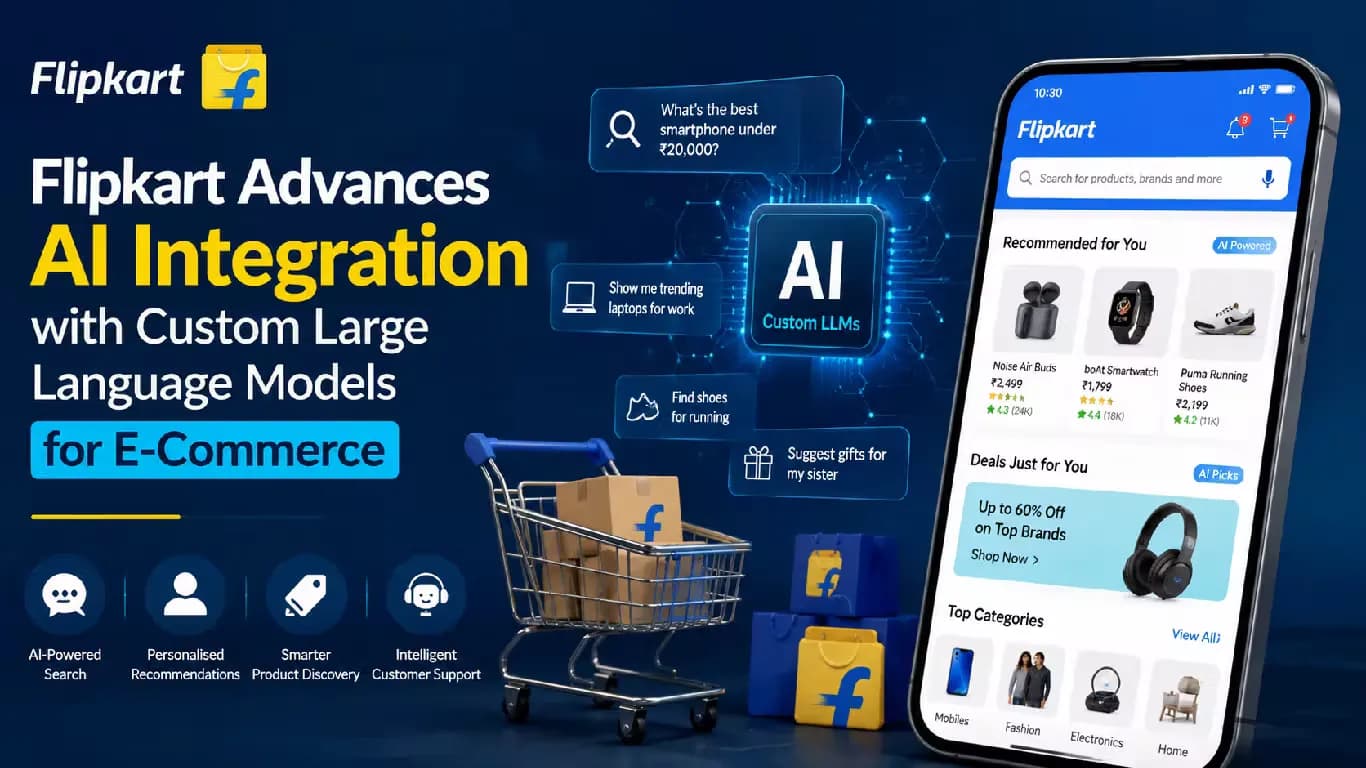
Flipkart Advances AI Integration with Custom Large Language Models for E-Commerce



Follow Us:


8,336 views
Flipkart is increasing its investment in artificial intelligence, focusing on building specialised large language models (LLMs) for e-commerce. According to Balaji Thiagarajan, Flipkart’s chief product and technology officer, AI now generates about 40 percent of the company’s code. The company aims to create an 'agentic e-commerce platform' by combining frontier AI models with proprietary models tailored for specific tasks.
Key Highlights
- Flipkart reports AI generates about 40 percent of its code across the company
- Over 250 AI models have been deployed in Flipkart’s ecosystem for specialised e-commerce tasks
- Competitor Amazon plans a $13 billion investment in India for cloud and AI infrastructure by 2030
- Industry-wide, AI-generated code is increasing, with OpenAI reporting 80 percent of code written by AI
Flipkart’s AI Model Strategy
Balaji Thiagarajan stated that Flipkart has deployed over 250 AI models across its ecosystem. He explained that relying solely on general-purpose models is not sufficient for the company’s needs. Instead, Flipkart is developing its own models to address specialised tasks in e-commerce. These models support various functions, including product discovery, conversational shopping, seller operations, and internal productivity.
Thiagarajan noted, 'Around 35-40 percent of our code is already generated by AI tools.' This figure aligns with trends seen at other technology companies. For example, Meesho, another e-commerce platform, reportedly uses AI to generate over 70 percent of its code. OpenAI President Greg Brockman previously stated that AI writes about 80 percent of all code at the AI startup.
Industry Trends and Future Outlook
AI agents have seen widespread adoption globally, especially with tools like Claude Code and Codex. Thiagarajan believes that companies will use a combination of external and internal AI models for different activities. He said, 'The future of AI will be a mixture of experts... many of the other experts will be models we build ourselves.' He emphasised that Flipkart’s differentiation comes from its data, engineering capabilities, and the development of specialised e-commerce LLMs.
While some companies, such as Uber and Walmart, have started reducing AI usage among employees due to rising costs, Flipkart remains focused on investment. Thiagarajan stated, 'We're not overly concerned about the ROI of AI right now because we're still in investment mode.' He added that the company is prioritising AI governance, including content moderation, response fidelity, human-in-the-loop systems, and reinforcement learning.
Competitive Landscape and Investments
As Flipkart increases its focus on AI, competitor Amazon is also expanding its presence in India. Amazon recently announced a $13 billion investment in India through 2030 to enhance its cloud and AI infrastructure. This brings Amazon’s total planned investment in the country to $48 billion.
The growing use of AI in code generation is part of a broader industry trend. OpenAI has revealed that 80 percent of its code is written by AI. Meanwhile, other major technology companies are adjusting their AI strategies. For instance, Meta has experienced slower-than-expected AI agent development, and Microsoft has established a new $2 billion company to advance AI, planning to staff it with 6,000 engineers.
Latest News

Reviews & Guides
View All


Samsung Galaxy Buds 4 Pro Review: क्या ₹22,999 में मिलते हैं सबसे बेहतरीन प्रीमियम वायरलेस ईयरबड्स?

कंटेंट क्रिएटर के लिए सबसे दमदार बैटरी लाइफ वाले Windows लैपटॉप, 18 घंटे की मिलेगी बैटरी लाइफ

Samsung Galaxy S26 Ultra क्यों है साल का सबसे बेहतरीन स्मार्टफोन? जानें 5 बड़े कारण

MacBook Neo Review: सस्ता नहीं, Apple का मास्टरस्ट्रोक है ये Laptop!

Samsung Galaxy S26 Ultra Review: AI से लेकर प्राइवेसी डिस्प्ले है सबसे खास, जानें कैसी है परफॉरमेंस
Vivo V70 Elite Review 2026: Price in India, Specs, Features

Best 4K TVs Under ₹40,000 in India (2026)

Lava Virat Curve 5G Price in India, Launch Date & Specs 2026

Samsung Galaxy S26 FE Price in India ₹79,999, Specs & Offers

Samsung Galaxy S26 FE vs iPhone 17: Price & Specs

Best Haier TV in India 2026: Top Models, Prices & Specs

Best Haier LED TV Under Rs 30,000 in India