


- News
- All News
- Mobiles
- Laptops
- Watches
- Cameras
- Printers
- Refrigerators
- Televisions
- Air Conditioners
- Washing Machines
- Air Purifiers
- Water Purifiers
- Expert Reviews
- All Reviews
- Mobiles
- Laptops
- Watches
- Cameras
- Printers
- Refrigerators
- Televisions
- Air Conditioners
- Washing Machines
- Air Purifiers
- Water Purifiers
- Articles
- All Articles
- Mobiles
- Laptops
- Watches
- Cameras
- Printers
- Refrigerators
- Televisions
- Air Conditioners
- Washing Machines
- Air Purifiers
- Water Purifiers
- Videos
- Videos

Ad
Samsung Reportedly Plans 2027 TV Lineup Overhaul With Ultra, Plus and Basic Tiers


on Google
on Google
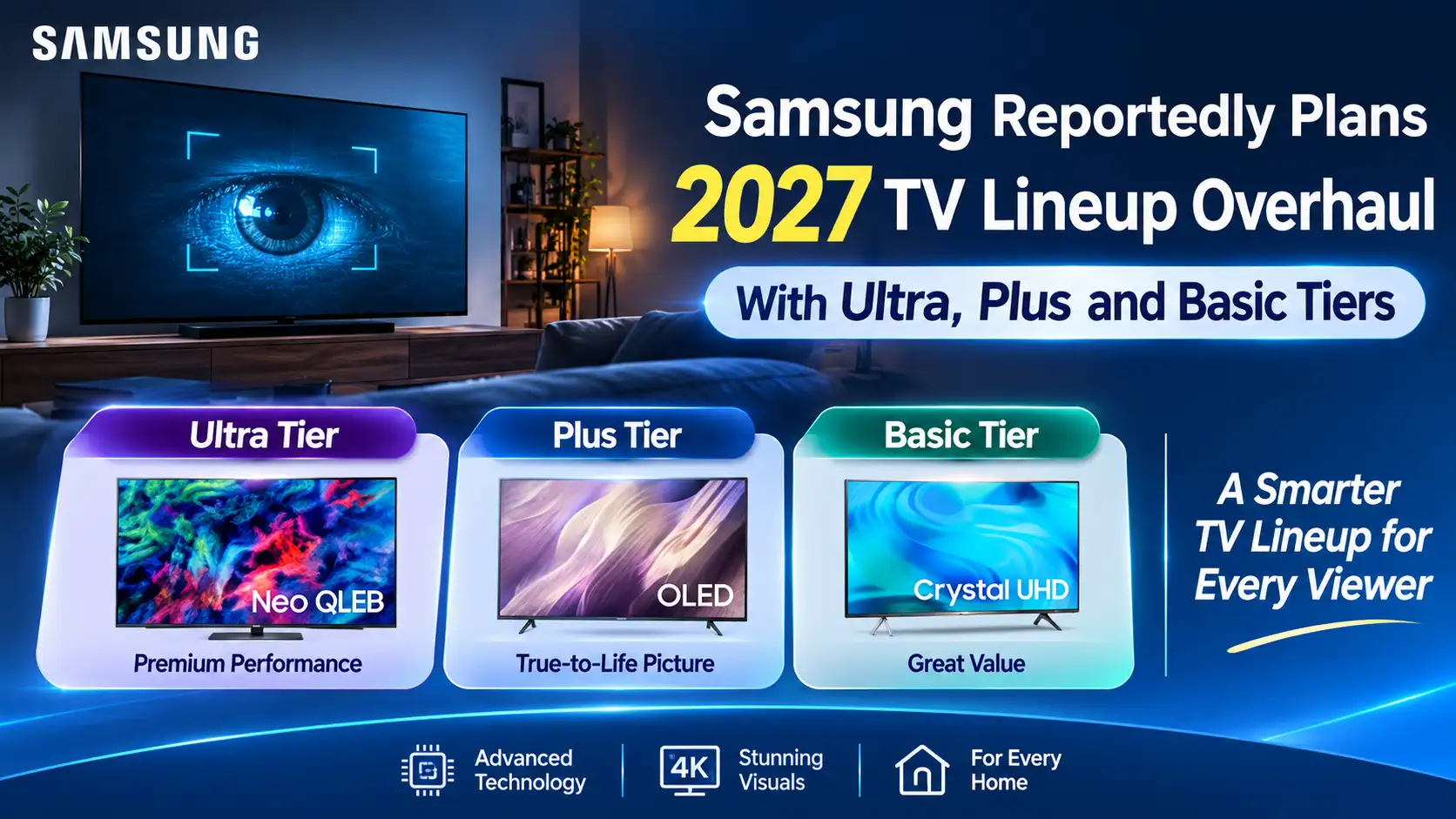
The proposed structure could mark a substantial shift in Samsung's product positioning, as the company faces rising competition from Chinese television manufacturers that are offering advanced display technologies at competitive prices. The strategy is said to be aimed at simplifying product choices and reinforcing the company’s focus on artificial intelligence and connected television services.
The proposed three-tier structure is unlikely to affect the entry-level Crystal UHD LCD television range. The new naming approach also mirrors Samsung’s Galaxy S smartphone portfolio that includes standard, Plus and Ultra models.
Key Highlights
Samsung is reportedly planning to launch three television categories in 2027, namely AI TV Basic, Plus and Ultra, while keeping Crystal UHD models separate.
OLED and Micro RGB televisions are expected to be placed in the Ultra category, with Mini LED models potentially in the Basic tier.
Samsung reportedly wants to raise its annual TV shipments from 35 million units in 2026 to over 40 million in 2027.
Samsung 2027 TV Lineup May Introduce Three New Categories
Samsung is reportedly planning a major restructuring of its television portfolio for 2027 with a simplified three-tier strategy that is designed to make its premium and advanced television offerings easier to distinguish. The company is contemplating the addition of AI TV Basic, Plus and Ultra categories for its upcoming television range.
What Display Technologies Could Feature In Each Tier?
The reported restructuring could alter how Samsung positions its various display technologies. Mini LED LCD televisions are expected to occupy the Basic category, while OLED and Micro RGB models may become the main offerings in the Ultra segment.
This would put Samsung’s more advanced display technology into a clear premium category, and could help customers more easily understand the difference between product ranges.
Proposed category | Expected display technology | Positioning |
AI TV Basic | Mini LED LCD | Advanced entry-level television range |
AI TV Plus | Not yet confirmed | Mid-range and upper-mid-range segment |
AI TV Ultra | OLED and Micro RGB | Premium television range |
Separate category | Crystal UHD LCD | Entry-level television segment |
The Plus category remains the biggest question mark. With Samsung reportedly planning to phase out its QLED LCD televisions in 2027, it’s unclear which display technologies will fill the gap between Basic and Ultra.
The report also doesn’t say whether Samsung will continue to make 8K TVs as part of its next-generation lineup.
Samsung Reportedly Plans To Phase Out QLED LCD TVs
Another big piece of news is Samsung’s supposed plan to kill off its QLED LCD TV range next year. The move could signal a wider shift toward a simplified display technology portfolio.
Samsung has traditionally used the QLED branding to differentiate its quantum-dot LCD televisions from standard LCD televisions. The proposed changes, however, could put a bigger emphasis on Mini LED, OLED and Micro RGB technologies.
Micro RGB televisions are particularly interesting because they improve colour reproduction and display performance by using red, green and blue LED backlights, and this technology is designed to offer more accurate colour control than traditional LCD televisions using regular backlighting schemes.
OLED televisions, however, use self-emissive pixels that can individually turn off to produce deep blacks and high contrast. Samsung could mix OLED and Micro RGB models in the Ultra category to satisfy different premium television tastes.
But the reported Mini LED positioning also raises questions about product specifications and how Samsung will differentiate its upcoming models from competing technologies.
AI Subscription Services Could Shape Samsung's TV Strategy
Samsung is said to be also mulling a business strategy that leans more on artificial intelligence and subscription-based services, beyond the hardware changes.
Rather than depending mainly on profits from sales of TV hardware, the company may seek to sell more devices at lower margins and make revenue regularly through subscriptions and connected services.
It might also help Samsung build a more powerful television ecosystem by encouraging customers to stick with its software, entertainment platforms and AI-powered features for longer periods of time.
The strategy also mirrors a broader movement within the consumer electronics industry where makers are increasingly tapping software-based revenue avenues in addition to traditional product sales.
Samsung Targets More Than 40 Million TV Shipments In 2027
Samsung is reportedly targeting to boost its annual television shipments from around 35 million units in 2026 to over 40 million in 2027. To hit the target, the company would have to ship at least five million more units.
There’s a simpler product structure, better premium positioning and more subscription opportunities that could support this ambition. But competition from Chinese manufacturers is still a big hurdle, especially in price-sensitive markets.
The Samsung TV range will debut in January 2027 at the Consumer Electronics Show (CES) in Las Vegas, and the Basic, Plus and Ultra categories, with their expected display tech, should be treated as reported plans and not confirmed specs until the official announcement.
Ad
Ad
Confused? Choose Your Phone
What Matters Most


Get TheWeekly Brief
One email each morning: the launches,
the price changes and the reviews
worth reading.

Ad
Ad
 |

807, 808, 8th Floor,
IRIS Tech Tower Sohna Road Sector 48,
Gurugram, Haryana - 122018