
Ad
Netrasemi Develops India’s First 12nm Edge AI Chip, Targets Defence and Enterprise Sectors
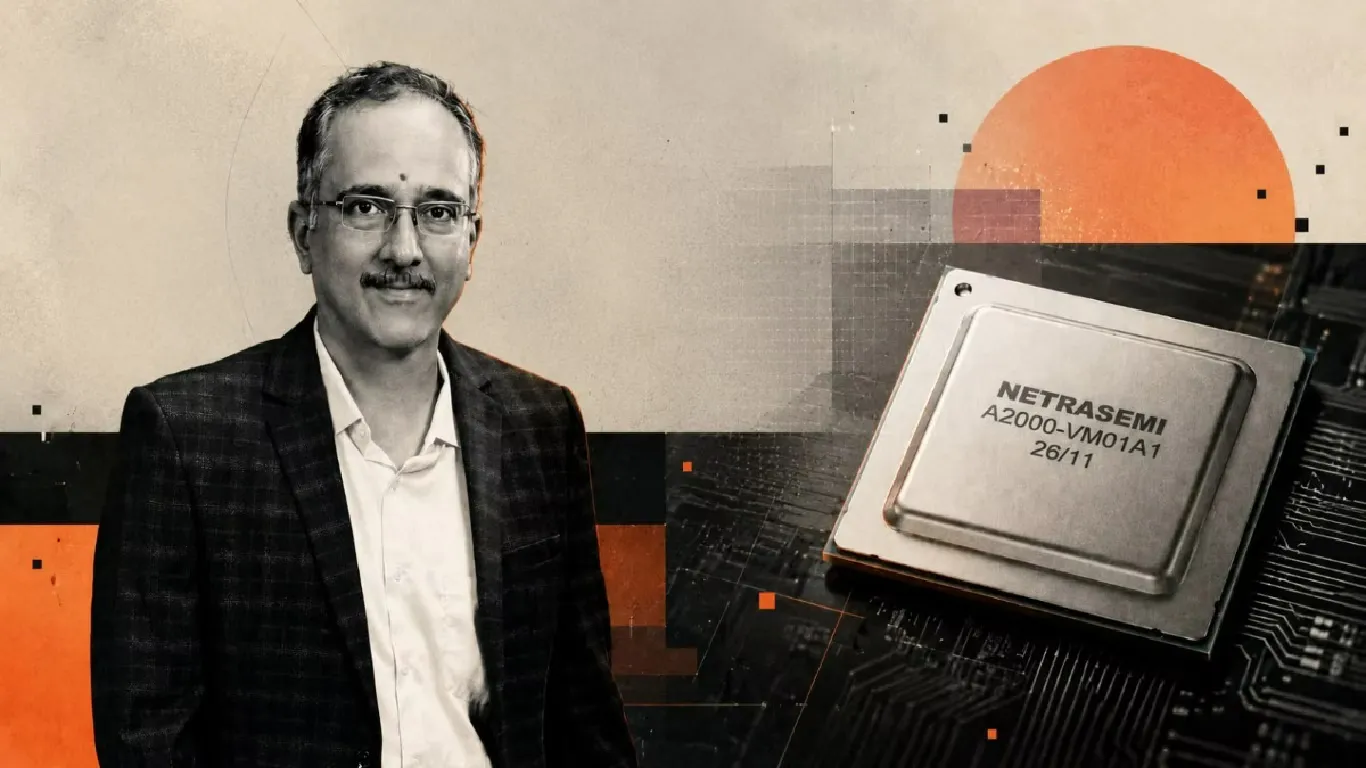
In 1999, Jyothis Indirabhai faced the impact of global sanctions after India’s Pokhran 2 nuclear tests. At the time, he worked as a semiconductor consultant for Hitachi in Japan, focusing on 180nm technology. Sanctions barred Indian engineers from working on technologies below 350nm, leading to the cancellation of his project and his relocation to the United States.
Key Highlights
- Netrasemi developed India's first 12nm Edge AI system-on-chip called the A2000.
- The A2000 chip supports over 100 commercial applications and targets national defence needs.
- Production costs per chip are estimated at Rs 50 to Rs 100 Crores.
- Netrasemi plans to double its 91-member engineering team for future projects.
- India's semiconductor ecosystem gained momentum after the 2021 India Semiconductor Mission.
Indirabhai spent two decades in Silicon Valley, contributing to wireless startups and working as a GPU design manager at Intel for nearly ten years. By 2026, he returned to Trivandrum as CEO and co-founder of Netrasemi, a company focused on designing sovereign AI chips for India.
Netrasemi’s Growth and A2000 Chip Launch
Netrasemi was founded in 2020 by a three-person team. It has since grown to a 91-member engineering group. The company recently achieved “silicon bring-up” for the A2000, India’s first 12nm Edge AI system-on-chip (SoC). The A2000 supports over a hundred commercial applications, including retail analytics, smart city infrastructure, and advanced robotics. However, its most significant use may be in national defence.
AI and technology are reshaping global warfare. Indirabhai emphasizes that defence now relies on AI, as seen in recent conflicts. He notes that secure, local computing is essential, especially during geopolitical tensions. The A2000 chip processes high-resolution vector data, such as live video streams and radar signals, in real time without depending on external cloud infrastructure.
When Indirabhai began developing intellectual property (IP) cores in India in 2017, the local semiconductor ecosystem was limited. Securing investment was challenging until the India Semiconductor Mission launched in late 2021. The government’s Rs 76,000 crore initiative introduced Design-Linked Incentives (DLI) for fabless startups and Production-Linked Incentives (PLI) for manufacturing. This support shifted investor interest, and Netrasemi became a leading design-led chip innovator.
Fabless Model and Production Process
Indirabhai advocates for the fabless semiconductor model. He points out that the United States holds over 50 percent of global semiconductor revenue and a 70 percent share in fabless design. Companies like Nvidia, Qualcomm, and AMD follow this approach. India’s talent pool supports this model, with 20 to 25 percent of global semiconductor engineers originating from India, and 95 percent working in design and fabless domains.
After finalizing the A2000’s design, Netrasemi sent it to Taiwan Semiconductor Manufacturing Company (TSMC) for fabrication. The silicon returned in March, passed initial validation, and is now in field-testing with early-access customers. The most expensive production step is creating the permanent “mask set” for mass manufacturing. Netrasemi aims to start full-scale commercial production by mid-next year, with production costs per chip estimated at Rs 50 to Rs 100 Crores. Indirabhai notes that producing the chip in the US would cost three to four times more.
The choice of a 12nm process node was deliberate to achieve high processing power and efficiency. The A2000 can handle multiple high-resolution video streams and complex AI algorithms in real time. Netrasemi developed its own neural processors, vision processing units, image signal processors, and video compression units, rather than relying on foreign IP blocks.
Future Roadmap and Industry Impact
Netrasemi is developing two additional chips: the R1000, a low-power AI microcontroller for IoT devices, and the A4000, a high-performance chip for enterprise AI servers and tactical command centers, targeted for release next year. The company plans to double its engineering team to meet growing demand, especially from the Indian defence sector.
Primary investors include Zoho and Unicorn India Ventures. Indirabhai believes that building a self-sustaining tech and AI ecosystem in India is crucial. By providing local OEMs with early access to chips like the A2000 and native software development kits, India can move from being an assembly hub to a product nation.
For Indirabhai, AI represents a major opportunity for India. He stresses the importance of creating and selling systems globally, positioning India as a leader in technology innovation.
Ad

Instagram Introduces Reorder Grid Feature and Paid Subscription in India
Instagram has introduced the Reorder Grid feature, allowing users to rearrange posts on their profile. Meta also launched a paid subscription in India for Rs 299 per month, offering additional customisation tools and insights.
09-Jun-2026 05:30 AM

Honor X80 Pro Max Leak Reveals 11,000mAh Battery and 6.8-inch AMOLED Display
A recent leak suggests Honor may launch an X80 Pro Max with an 11,000mAh battery, 90W fast charging, and a 6.8-inch AMOLED display. The device is also expected to feature water resistance and advanced biometric security.
09-Jun-2026 02:30 AM

US Adds Alibaba, Baidu, BYD, and Unitree to Chinese Military Support List
The US Department of Defense has added Alibaba, Baidu, BYD, and Unitree to its 1260H list, targeting 188 Chinese firms linked to military support. This action may limit contracts and funding, increasing US-China tech tensions.
08-Jun-2026 09:30 PM

Samsung Releases One UI 8.5 Update for M15 and Xcover7 in Select Markets
Samsung has released the One UI 8.5 update for the Galaxy M15 in Korea and the Xcover7 in Southeast Asia. The update includes the May 2026 security patch and will expand to more regions soon.
08-Jun-2026 09:30 PM

Studies Link iPhone and Smartphones to Global Decline in Birth Rates Since 2007
Recent studies suggest the rise of the iPhone and smartphones contributed to a global decline in birth rates since 2007. Researchers found significant drops in fertility among young women in the US and similar trends worldwide.
08-Jun-2026 07:30 PM

OnePlus to Launch N Series Smartphones in India Under INR 20,000
OnePlus is set to introduce the N series, a new entry-level smartphone line for India priced below INR 20,000. The N series will launch in July 2026 and compete with Redmi, Realme, and Poco in the budget segment.
08-Jun-2026 07:30 PM
Ad
Ad





Latest Televisions In India





Upcoming Televisions In India


Ad
Ad
 |
|
Delente Technologies Pvt. Ltd.
807, 808, 8th Floor,
IRIS Tech Tower Sohna Road Sector 48,
Gurugram, Haryana - 122018