



Ad
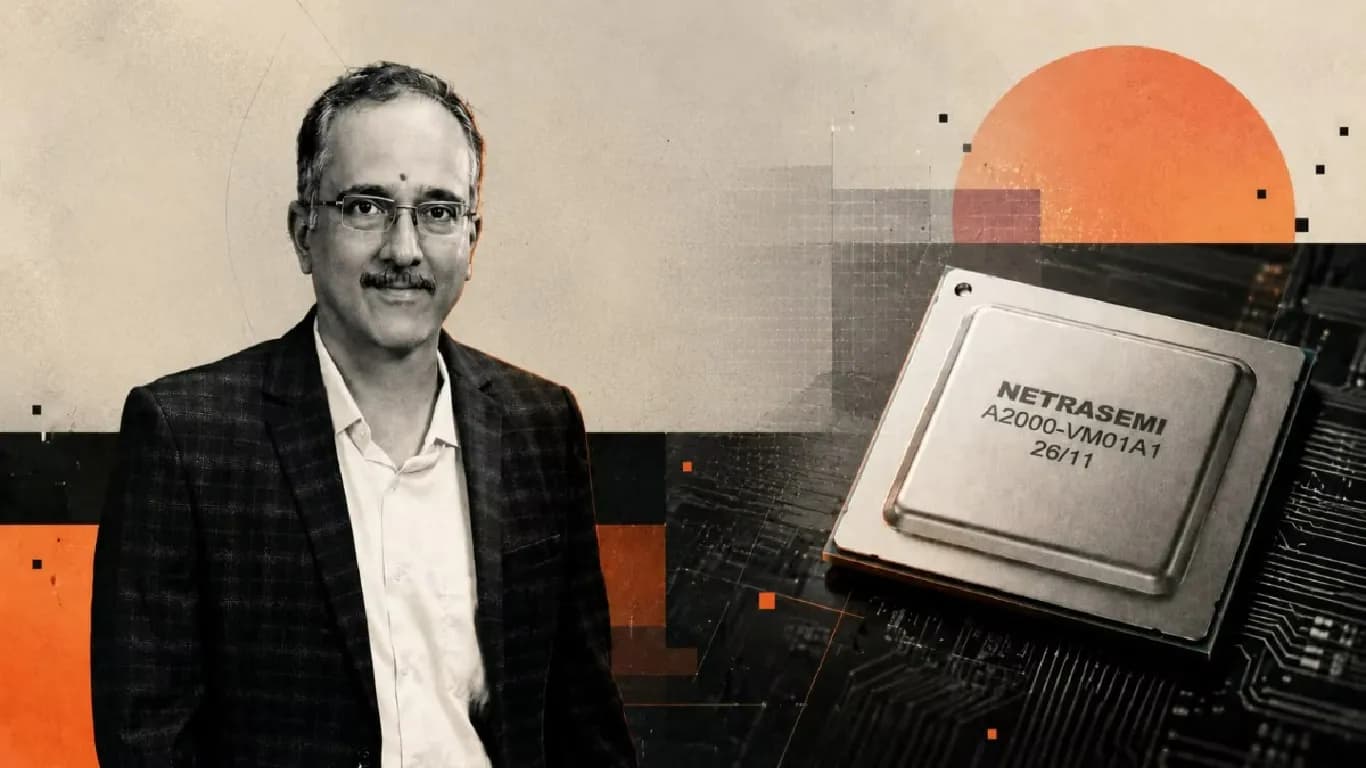
Netrasemi Develops India’s First 12nm Edge AI Chip, Targets Defence and Enterprise Sectors



Follow Us:


6,145 views
In 1999, Jyothis Indirabhai faced the impact of global sanctions after India’s Pokhran 2 nuclear tests. At the time, he worked as a semiconductor consultant for Hitachi in Japan, focusing on 180nm technology. Sanctions barred Indian engineers from working on technologies below 350nm, leading to the cancellation of his project and his relocation to the United States.
Key Highlights
- Netrasemi developed India's first 12nm Edge AI system-on-chip called the A2000.
- The A2000 chip supports over 100 commercial applications and targets national defence needs.
- Production costs per chip are estimated at Rs 50 to Rs 100 Crores.
- Netrasemi plans to double its 91-member engineering team for future projects.
- India's semiconductor ecosystem gained momentum after the 2021 India Semiconductor Mission.
Indirabhai spent two decades in Silicon Valley, contributing to wireless startups and working as a GPU design manager at Intel for nearly ten years. By 2026, he returned to Trivandrum as CEO and co-founder of Netrasemi, a company focused on designing sovereign AI chips for India.
Netrasemi’s Growth and A2000 Chip Launch
Netrasemi was founded in 2020 by a three-person team. It has since grown to a 91-member engineering group. The company recently achieved “silicon bring-up” for the A2000, India’s first 12nm Edge AI system-on-chip (SoC). The A2000 supports over a hundred commercial applications, including retail analytics, smart city infrastructure, and advanced robotics. However, its most significant use may be in national defence.
AI and technology are reshaping global warfare. Indirabhai emphasizes that defence now relies on AI, as seen in recent conflicts. He notes that secure, local computing is essential, especially during geopolitical tensions. The A2000 chip processes high-resolution vector data, such as live video streams and radar signals, in real time without depending on external cloud infrastructure.
When Indirabhai began developing intellectual property (IP) cores in India in 2017, the local semiconductor ecosystem was limited. Securing investment was challenging until the India Semiconductor Mission launched in late 2021. The government’s Rs 76,000 crore initiative introduced Design-Linked Incentives (DLI) for fabless startups and Production-Linked Incentives (PLI) for manufacturing. This support shifted investor interest, and Netrasemi became a leading design-led chip innovator.
Fabless Model and Production Process
Indirabhai advocates for the fabless semiconductor model. He points out that the United States holds over 50 percent of global semiconductor revenue and a 70 percent share in fabless design. Companies like Nvidia, Qualcomm, and AMD follow this approach. India’s talent pool supports this model, with 20 to 25 percent of global semiconductor engineers originating from India, and 95 percent working in design and fabless domains.
After finalizing the A2000’s design, Netrasemi sent it to Taiwan Semiconductor Manufacturing Company (TSMC) for fabrication. The silicon returned in March, passed initial validation, and is now in field-testing with early-access customers. The most expensive production step is creating the permanent “mask set” for mass manufacturing. Netrasemi aims to start full-scale commercial production by mid-next year, with production costs per chip estimated at Rs 50 to Rs 100 Crores. Indirabhai notes that producing the chip in the US would cost three to four times more.
The choice of a 12nm process node was deliberate to achieve high processing power and efficiency. The A2000 can handle multiple high-resolution video streams and complex AI algorithms in real time. Netrasemi developed its own neural processors, vision processing units, image signal processors, and video compression units, rather than relying on foreign IP blocks.
Future Roadmap and Industry Impact
Netrasemi is developing two additional chips: the R1000, a low-power AI microcontroller for IoT devices, and the A4000, a high-performance chip for enterprise AI servers and tactical command centers, targeted for release next year. The company plans to double its engineering team to meet growing demand, especially from the Indian defence sector.
Primary investors include Zoho and Unicorn India Ventures. Indirabhai believes that building a self-sustaining tech and AI ecosystem in India is crucial. By providing local OEMs with early access to chips like the A2000 and native software development kits, India can move from being an assembly hub to a product nation.
For Indirabhai, AI represents a major opportunity for India. He stresses the importance of creating and selling systems globally, positioning India as a leader in technology innovation.
Latest News


Reviews & Guides
View All


Samsung Galaxy Buds 4 Pro Review: क्या ₹22,999 में मिलते हैं सबसे बेहतरीन प्रीमियम वायरलेस ईयरबड्स?

कंटेंट क्रिएटर के लिए सबसे दमदार बैटरी लाइफ वाले Windows लैपटॉप, 18 घंटे की मिलेगी बैटरी लाइफ

Samsung Galaxy S26 Ultra क्यों है साल का सबसे बेहतरीन स्मार्टफोन? जानें 5 बड़े कारण

MacBook Neo Review: सस्ता नहीं, Apple का मास्टरस्ट्रोक है ये Laptop!

Samsung Galaxy S26 Ultra Review: AI से लेकर प्राइवेसी डिस्प्ले है सबसे खास, जानें कैसी है परफॉरमेंस
Vivo V70 Elite Review 2026: Price in India, Specs, Features

Best Phone Under ₹10,000 for Elderly and Senior Citizens

Haier 32, 43 & 55 Inch LED TV: Full Specifications & Price Comparison

Best 4K TVs Under ₹40,000 in India (2026)

Lava Virat Curve 5G Price in India, Launch Date & Specs 2026

Samsung Galaxy S26 FE Price in India ₹79,999, Specs & Offers

Samsung Galaxy S26 FE vs iPhone 17: Price & Specs