



Ad
Delhi Police Use AI Facial Recognition Vans at Jantar Mantar Protests



Follow Us:


9,402 views
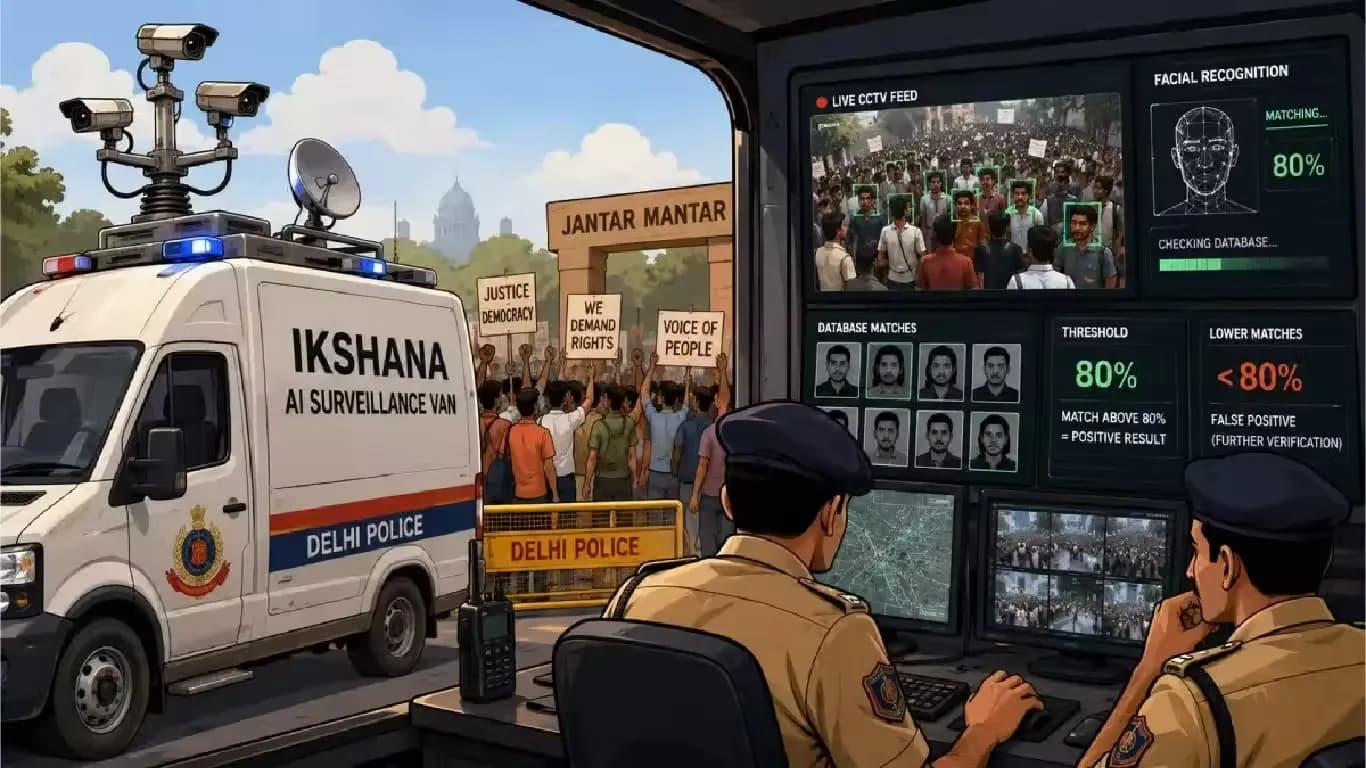
Delhi Police have deployed AI-powered facial recognition vans at Jantar Mantar, where student protests are ongoing. Videos from the protest site, widely shared on X, show police using surveillance vehicles equipped with 360-degree cameras and live monitoring screens. These screens display names, photographs, and other details of selected protesters. The technology has sparked debate about privacy and the databases being used for identification.
Key Highlights
- Delhi Police deploy AI facial recognition vans at Jantar Mantar student protests.
- Technology matches faces with police criminal database, not officially linked to Aadhaar.
- Protesters express privacy concerns and some cover faces to avoid identification.
- No fixed timeline for deletion of protest surveillance footage by police.
- Legal challenge argues monitoring violates rights to privacy and peaceful assembly.
AI Surveillance at Protest Site
According to an Indian Express report, Delhi Police have stationed two surveillance vehicles near Jantar Mantar. One vehicle acts as a mobile monitoring unit, receiving live feeds from CCTV cameras in the area. The second vehicle uses artificial intelligence to analyze video feeds and compare faces with images stored in a police database. The facial recognition system operates inside the Ikshana vehicle, which was first introduced before the 2023 G20 Summit as part of the city's surveillance infrastructure.
Authorities state the technology is not intended to identify every protester. Instead, it is designed to alert police if someone with a criminal record is present in the crowd. A senior police officer told Indian Express, "We have a large database of criminals, with their pictures. So, we run facial recognition on the footage that is received from the various CCTVs in the area, to see if it flags any face the software matches with someone on our criminal database."
Concerns Over Data and Privacy
The viral videos do not mention Aadhaar, and there is no official confirmation that the system is linked to the Aadhaar database. However, because the system can pull up personal information after scanning faces, many social media users have questioned whether it accesses government databases. The footage only shows faces being matched with information on a police system. Authorities have not clarified which database is being used to identify individuals.
Protesters report feeling intimidated by the visible surveillance. Many students have started covering their faces, fearing that images taken during the protest could be stored and used against them later. One UPSC aspirant told Indian Express that participants were hiding their identities to avoid being profiled while preparing for government jobs.
Questions remain about how long police will keep the footage collected during the protests. A senior officer said there is no fixed timeline for deleting the recordings, especially if they could become relevant to future investigations.
Legal and Public Reactions
The use of facial recognition vans has become the subject of a legal challenge. A petition before the Delhi High Court argues that continuous monitoring of protesters violates their rights to privacy and peaceful assembly. Delhi Police have responded in court that videography at the protest site is being done only to maintain law and order and ensure public safety, not for surveillance purposes, according to the report.
Latest News


Reviews & Guides
View All


Samsung Galaxy Buds 4 Pro Review: क्या ₹22,999 में मिलते हैं सबसे बेहतरीन प्रीमियम वायरलेस ईयरबड्स?

कंटेंट क्रिएटर के लिए सबसे दमदार बैटरी लाइफ वाले Windows लैपटॉप, 18 घंटे की मिलेगी बैटरी लाइफ

Samsung Galaxy S26 Ultra क्यों है साल का सबसे बेहतरीन स्मार्टफोन? जानें 5 बड़े कारण

MacBook Neo Review: सस्ता नहीं, Apple का मास्टरस्ट्रोक है ये Laptop!

Samsung Galaxy S26 Ultra Review: AI से लेकर प्राइवेसी डिस्प्ले है सबसे खास, जानें कैसी है परफॉरमेंस

Vivo V70 Elite Review 2026: Price in India, Specs, Features

Best Phone Under ₹10,000 for Elderly and Senior Citizens

Haier 32, 43 & 55 Inch LED TV: Full Specifications & Price Comparison

Best 4K TVs Under ₹40,000 in India (2026)

Lava Virat Curve 5G Price in India, Launch Date & Specs 2026

Samsung Galaxy S26 FE Price in India ₹79,999, Specs & Offers

Samsung Galaxy S26 FE vs iPhone 17: Price & Specs